E.B. DOANE
PATRIOT, PIONEER
By William Urban
1970, 2011
FOREWORD
The writing of any biography involves luck, hard work, travel, research, and
the help of many people. This biography was no different. The letters on
which it is based were loaned to me by Leslie Doane, who had been given them
because he and E.B. Doane had shared the experience of being a
prisoner-of-war, he at Bataan. I sought out further documentary evidence
from the National Archives, the Iowa Yearly Meeting of the Society of
Friends, the Iowa State Historical Society, the Kansas Historical Society,
several local Iowa and Kansas libraries, and the Monmouth College Library.
Also I received much assistance from my Doane relatives.
It has been possible for me to visit the sites of E.B. Doane’s activity in
Iowa and Kansas, and to follow his routes across Missouri and Arkansas, and
Tennessee, Georgia, and South Carolina. Living close to Iowa, and having
relatives in Kansas, these visits were more than just cursory, and made the
writing of the biography much more enjoyable.
It should be noted that the name Eleazar has various spellings. Eleazer and
Eleazor are most common. The King James version of the Bible spells it
El-a’-zär (Eleazar and Ithamar are the surviving sons of Aaron; see
Leviticus 10), but E.B. Doane
spelled his name, and his family name as well, in various ways and preferred
to be called E.B. or Captain Doane.
William L. Urban
Lee L. Morgan Professor
of History and International Studies
Monmouth College, Monmouth
IL
ELEAZAR BALES DOANE: PATRIOT, PIONEER
That numerous descendants of the Doane
family are to be found in north central Kansas today in only a reflection of a
wider movement of Quaker pioneers over a period of many years. The original
settlement in Pennsylvania saw a Daniel Doane migrate there from Massachusetts,
then, being dissatisfied with the insistence that he abandon his interest in
astronomy, moved to North Carolina; Jesse Doane, finding that his abolitionist
views were unwelcome, moved with other Quakers to a settlement near Knoxville;
Robert Doane moved to Indiana, then to Iowa; finally E.B. Doane emigrated to
Kansas, there to leave his Quaker faith for lack of fellow co-religionists. This
background of pioneer ancestry with a deep commitment to a difficult faith
explains much about the central figure of this investigation, Eleazar Bales
Doane.
Eleazar Bales Doane lived in a crisis moment in American history. The
movement west and the conflict over slavery were at their height, and he was
involved in both. As America grew, and changed, and suffered, he grew, and
changed, and suffered with her.
Eleazar Bales Doane was born in Morgan
County, Indiana, April 24, 1840, in a frontier community of Quakers. His father,
Robert, had come to Indiana with friends and relatives at the age of
twenty-three and leased a farm. Two years later, on June 12, 1839, Robert
married his cousin, Rachel Doane. Eleazar was the eldest child of seven, but
only four survived infancy: Eleazar (1840), Ithamar (1841), David (1847), and
Mary (1849). The names chosen for the children illustrate the parents’ deep
knowledge of and respect for the Bible, an attitude they passed in to the
children.
Eleazar’s memory of Indiana was to be dim, however, because pioneers were
always eager to be on the move westward, and his family was in the pioneer
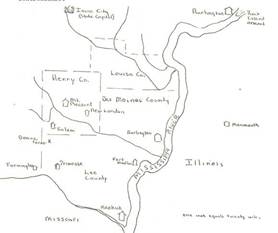
tradition. In 1847 His parents migrated to southeastern Iowa, where large
numbers of Quakers were settling around the town of Salem. Robert Doane set out
alone, first purchasing land in Cedar township of Lee County, building a log
cabin, and then putting in his first crop. Afterwards he sent for his family.
Thus it was that the Doanes came to
Iowa. It was a good land, but untamed, and life was primitive. In 1850, when
Eleazar was but ten years old, an eastern Quaker described it:
The residences of the settlers in this place, scattered over the prairie land,
are chiefly log buildings; the settlement being several miles in extent. In the
summer season, while the grass is green, the country, with the cabins and little
surrounding improvements dotted over it, has a picturesque appearance; yet to
the stranger it gives a sensation of lonesomeness.
Eleazar was young, but in those
days everyone worked, and the eldest son of a pioneer family undoubtedly had
many chores thrust upon him. While his father worked the two hundred and twelve
acre farm, Eleazar probably assisted his mother in caring for the animals and
the garden. Later he would work in the fields. There being but a year’s
difference in age, his brother Ithamar was probably a constant companion in work
and play, and a firm friendship bound them together. Unhappily, in 1852, when
Eleazar was twelve, his mother and his infant sister died. His life was greatly
affected by this tragedy.
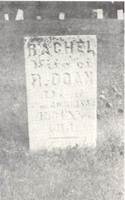 Robert
Doane accepted the loss of his wife and help-mate. On the frontier there was
little time to mourn. Life was hard, and many died young. The survivors had work
to do, and Eleazar’s father devoted himself to the rearing of his four young
children. He never remarried. He never traveled much. But he built a model farm,
with a fine house and barn. And he was a well-read man, deeply versed in the
Bible and the classics. He was interested in politics, and was undoubtedly an
early member of the Republican party. And he brought up his family to be
likewise involved in important ideas and issues.
Robert
Doane accepted the loss of his wife and help-mate. On the frontier there was
little time to mourn. Life was hard, and many died young. The survivors had work
to do, and Eleazar’s father devoted himself to the rearing of his four young
children. He never remarried. He never traveled much. But he built a model farm,
with a fine house and barn. And he was a well-read man, deeply versed in the
Bible and the classics. He was interested in politics, and was undoubtedly an
early member of the Republican party. And he brought up his family to be
likewise involved in important ideas and issues.
 Robert Doane was not, however, what Quakers call a “weighty Friend.” He
had been disowned by White Lick Monthly Meeting in Indiana before his removal to
Iowa, and now his farm lay several miles from the Meeting House in Salem,
separated by a creek bed impassible in bad weather. It was a difficult enough
journey in good times, and Robert had much work to make his farm support his
family. Apparently he and Rachel had notified the Salem Meeting of their
intention to unite in membership there in 1851, but Robert submitted his request
that he and his minor children (David, Mary and Sarah Elizabeth, who had died in
April) be united with Salem Monthly Meeting of the Society of Friends. This
request was discussed at length by the membership. At that time in Quaker
history, Friends were much concerned with maintaining their purity, which meant
separation from the “world’s people.” Quakers were extremely strict Christians.
They wore the plain clothing, used the plain talk, and pursued lives of utmost
simplicity and piety. They disowned members for “marrying out of unity with
Friends,” cursing, going to court, dancing, participating in military
activities, and other “worldly” activities. They held strong positive
testimonies as well, taking unpopular stands against human slavery and for fair
treatment of the Indians. If one did not measure up to these testimonies in
every way, it did not mean that one was not an exemplary Christian by other,
more conventional standards. Furthermore, there was a schism among Iowa Friends
were demanding a more militant stand on the question of Abolition. As early as
1845 numbers of these Friends had felt constrained to withdraw from Salem
Monthly Meeting over this issue and, although many reunited with Salem Monthly
Meeting in succeeding years, antagonism still remained.
Robert Doane was not, however, what Quakers call a “weighty Friend.” He
had been disowned by White Lick Monthly Meeting in Indiana before his removal to
Iowa, and now his farm lay several miles from the Meeting House in Salem,
separated by a creek bed impassible in bad weather. It was a difficult enough
journey in good times, and Robert had much work to make his farm support his
family. Apparently he and Rachel had notified the Salem Meeting of their
intention to unite in membership there in 1851, but Robert submitted his request
that he and his minor children (David, Mary and Sarah Elizabeth, who had died in
April) be united with Salem Monthly Meeting of the Society of Friends. This
request was discussed at length by the membership. At that time in Quaker
history, Friends were much concerned with maintaining their purity, which meant
separation from the “world’s people.” Quakers were extremely strict Christians.
They wore the plain clothing, used the plain talk, and pursued lives of utmost
simplicity and piety. They disowned members for “marrying out of unity with
Friends,” cursing, going to court, dancing, participating in military
activities, and other “worldly” activities. They held strong positive
testimonies as well, taking unpopular stands against human slavery and for fair
treatment of the Indians. If one did not measure up to these testimonies in
every way, it did not mean that one was not an exemplary Christian by other,
more conventional standards. Furthermore, there was a schism among Iowa Friends
were demanding a more militant stand on the question of Abolition. As early as
1845 numbers of these Friends had felt constrained to withdraw from Salem
Monthly Meeting over this issue and, although many reunited with Salem Monthly
Meeting in succeeding years, antagonism still remained.
Since Robert Doane seems to have adhered to this abolitionist party (or,
at least, to its principles), the reluctance of Salem Friends to admit him to
membership is understandable. Indeed, Rachel Doane was buried in the Friends’
burial ground held by the Anti-slavery Meeting until 1862, when it was sold to
Salem Meeting. When Robert Doane and his minor children were finally united with
Salem Monthly Meeting, the
resulting ties were not close. The occasion of their admittance into membership
was also the last time that these Doanes were mentioned in the minutes of the
Monthly Meeting.
Perhaps they were among that group the answer to the Queries castigated: “there
is a manifest lack in others in so frequently neglecting the attendance of our
religious Meeting.
Nevertheless, there were preparatory Meetings closer to Robert Doane’s residence
and he did retain his membership in the Society of Friends to his death in 1889.
Always he was known as a devout and well-educated man, and he gave his children
a firm knowledge of the Bible and other religious works.
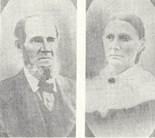 Eleazar’s
maternal grandparents, David and Ruth Doane, farmed one hundred and sixty acres
not far away. As a young man David had worked wherever he could to support his
family, but could not afford a farm until he emigrated to Iowa in 1848. By the
time of his death in 1862 he had become moderately prosperous.
David was not a model Friend either. Early in 1852 he was disowned by Salem
Meeting “for using unbecoming language,” and reunited only in 1858.
Eleazar’s
maternal grandparents, David and Ruth Doane, farmed one hundred and sixty acres
not far away. As a young man David had worked wherever he could to support his
family, but could not afford a farm until he emigrated to Iowa in 1848. By the
time of his death in 1862 he had become moderately prosperous.
David was not a model Friend either. Early in 1852 he was disowned by Salem
Meeting “for using unbecoming language,” and reunited only in 1858.
It is of some interest that young
Eleazar and Ithamar did not request membership in Salem Meeting. Although they
shared many of the testimonies common to Friends, they did not share the
adversion to warCthey
were willing to participate in that evil in order to eliminate a greater one,
human slavery. Certainly, although Eleazar received good religious training, he
was never closely associated with the Society of Friends in a formal capacity
and apparently frequented the social activities at nearby Sharon Presbyterian
Church. However, he was deeply beholden to Friends for their strong testimony
against slavery and their independence of spirit.
Slavery was the central and crucial
question of that era. Much earlier, when William Penn invited the German
settlers into Pennsylvania, the new immigrants asked how slavery was to be
reconciled with the Golden Rule. Friends became concerned and opposition to
slavery was a widely accepted testimony before the Revolutionary War. All
Eleazar’s Quaker ancestors shared this attitude. A great-grandfather left the
North Carolina because of hatred for slavery, and many Doanes were active in the
underground railroad in Indiana. Salem, Iowa, was a hotbed of Abolitionist
activity. Some Quakers there formed one of the four quarterly meetings of the
Indiana Yearly Meeting of Anti-Slavery Friends, and they made Salem into a major
center for the underground railroad, smuggling escaped slaves out of Missouri
into Canada. For obvious reasons, participation in such illegal activities was
kept secret, but it is quite likely that the Doanes assisted in violations of
the Fugitive Slave Act.
Their farm lay on the road from Missouri to Salem.
Eleazar’s education emphasized the
importance of the slavery issue. Among the first settlers of Salem was a
prominent anti-slavery Quaker educator who founded a school in that settlement.
Unfortunately, he died shortly afterward; however, he left behind a tradition
that led to the foundation of a short-lived college in Salem.
Ten miles to the north, in Mount Pleasant, a noted Abolitionist named Samuel
Luke Howe opened a High School for boys and an Academy for girls. His
newspapers, the Iowa Freeman and the Iowa True Democrat, strongly
opposed the Compromise of 1850 and all subsequent acts which tended to keep
slavery alive. Howe was in Kansas in 1856, helping Free Soilers defend Lawrence
against the Border Ruffians from Missouri, and often thereafter he was in the
company of John Brown. Though variously called a “madman, fanatic, and
agitator,” he was an influential figure. General Sherman, his pupil in Ohio,
later wrote: “Prof. Howe I consider to be the best teacher in the United
States.” Another former student wrote: “The students in Prof. Howe’s school drew
in Abolitionism with their Latin and their mathematics....To the end of their
lives will his students to be proud to admit the molding influence of that
mastermind.”
Eleazar Doane studied under Samuel Luke Howe.
This anti-slavery attitude was widely
held among Iowans in general, but often for very different reasons. Many workers
feared that the extension of slavery would lower wages. These hated and feared
even the Free Negroes, because Negroes would work wherever they could for
whatever wages they could obtain. Therefore, some whites sought not only to
eliminate slavery, but also to eliminate the Negro. Others saw slavery as a
threat to democracy. Only the rich could afford slaves, and in the South
plantation owners appeared to have disproportionate political influence. Iowans,
being largely yeoman farmers, hated slavery for the economic, political, and
social threat it represented. As early as 1854 the Whig candidate for governor
was elected on an anti-slavery platform. That same year the Republican party,
and even its candidate for President in 1860, Abraham Lincoln, was not an
Abolition party. In fact, Republican leaders were careful to emphasize that
their party did not advocate Abolition, but only opposed the extension of
slavery into the territories.
Eleazar Doane, a young man approaching
maturity in these turbulent years, had opportunity to participate in these
exciting political developments. Nearby in Illinois, within a day’s ride,
Lincoln and Douglas debated. In Iowa, pro- and anti-slavery orators spoke before
large audiences, and the ready communications afforded by the Mississippi River
kept Iowans informed as to public opinion in Louisiana, Mississippi, Tennessee,
Arkansas, and Missouri, areas where talk of secession was becoming increasing
serious. The Democratic party was badly divided; the Whig party was dying; and
thus the Republican party became the party of Union, the party of patriotism.
Eleazar Doane was undoubtedly a Republican from the beginning, for that party
endorsed unity and opposed slavery.
Therefore, when war broke out between
the North and the South in 1861, Eleazar Doane and his family were deeply
concerned. Not backward in any way, he attempted to enlist immediately. His
declaration read:
I, Eleazar Doane, desiring to enlist in the army of the United States for the
period of three years and 5 months of age, that I have never been discharged
from the United States service on account of disability, or by sentence of
court-martial, or by order before the expiration of a term of enlistment, and I
know of no impediment to my serving honestly and faithfully as a soldier for
three years or during the present war.
Witness W. W. Woods ELEAZAR
DOANE
I, Eleazar B. Doane do solemnly swear, that I will true allegiance to the United
States of America; and that I will serve them honestly and faithfully against
all their enemies or opposers whatsoever, and observe and obey the orders of the
President of the United States, and the orders of the officers appointed over
me, according to the rules and articles for the government of the armies of the
United States.
ELEAZAR B. DOANE
State of Iowa Des Moines County
Burlington Township
Subscribed and sworn
to before me by the said Eleazar B.
Doane
this 23rd day of September, A.D. 1861
5 ft. 7 in. high, light
Geo. Sampler,
complexion, hazel eyes, light
Justice of the Peace.
brown hair, and sandy whiskers,
Des Moines County, Iowa.
residence Cedar Ts.
Lee County, Iowa.
But Eleazar’s enlistment was not
accepted. The Iowa enlistment was filled to the legal limits, and the surplus
volunteers were told to wait; perhaps they would yet be needed. So he returned
to teaching. Probably he and his family hoped for a quick Union victory. Avid
readers, they followed the course of events through the local newspapers,
especially the Weekly Gate City, an abolitionist paper from Keokuk.
Most persons in the North believed that
the South would be overwhelmed in a few weeks, but the Battle of Bull Run
snuffed their hopes for an easy victory. As the North began to raise a larger
force for another invasion of Virginia, the South also used this time to train
new troops, so that when General McClellan moved south again in the summer of
1862, Lee was able to check him at the Seven Days Battlefield. It then became
obvious that a national effort was needed, and on July 2nd, 1862, President
Lincoln asked for 300,000 volunteers.
Within a fortnight Iowa’s Republican
governor issued a proclamation:”The time has come when men must make, as many
have already made, sacrifices of ease, comfort, and business for the cause of
the country.”
The anti-war agitation of Vallandingham and other Democrats was overwhelmed by
Republican editorials such as this one in the Burlington Hawkeye:
THERE IS A WAR—Little by little, day by day, the country is finding out there is
a war going on. For fifteen months armies have been in the field...But the great
mass of the people have not yet realized the gigantic importance of the
contest...The time seems to have come for greater exertion—a more thorough
awakening and a deeper determination.
Eleazar Doane had made his decision
earlier, and now that Iowans were authorized to raise twenty-two regiments,
Eleazar Doane and his brother Ithamar enlisted in the first of the volunteer
units to form, the 19th Iowa Infantry, which mobilized in August in
Keokuk.
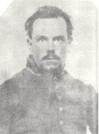 Eleazar
Doane gave up much to enlist. His farming and his teaching could wait, but would
a young lady named Amelia Cahill? She had come to Iowa with her mother, sister,
and step-father, and resided in Harrison township of Lee County, just south of
the Doane farm in Cedar Township.
Her brother had remained in Cincinnati to be reared in their grandfather’s
strict Irish Catholic home, but Amelia and Mary Jane apparently attended
services at Sharon Presbyterian Church (although their names do not appear on
the poorly-kept membership lists there). Amelia was just eighteen, and would
soon begin to teach school at nearby Primrose and Farmington. Perhaps she
promised to write to the young warrior. That was not uncommon and, to be sure,
some young ladies wrote to so many acquaintances in the army as to cause a local
scandal.
Eleazar
Doane gave up much to enlist. His farming and his teaching could wait, but would
a young lady named Amelia Cahill? She had come to Iowa with her mother, sister,
and step-father, and resided in Harrison township of Lee County, just south of
the Doane farm in Cedar Township.
Her brother had remained in Cincinnati to be reared in their grandfather’s
strict Irish Catholic home, but Amelia and Mary Jane apparently attended
services at Sharon Presbyterian Church (although their names do not appear on
the poorly-kept membership lists there). Amelia was just eighteen, and would
soon begin to teach school at nearby Primrose and Farmington. Perhaps she
promised to write to the young warrior. That was not uncommon and, to be sure,
some young ladies wrote to so many acquaintances in the army as to cause a local
scandal.
Eleazar Doane was so determined to enlist that he left his farm, his schooling,
and his romantic interests behind and went to war with a number of his Henry
County friends. One of these was Richard Root, a capable surveyor and scout of
some thirty years of age. He had spent several years in the Rockies, apparently
for adventure, and returned to Iowa to enlist as Lieutenant. Another was W.I.
Babb, made Hospital Steward of the 2nd Battalion because of his more advanced
education. Ithamar Doane, because of his education and connection with Prof.
Howe, perhaps because of his firmly expressed beliefs, was made 2nd Sergeant of
Captain Roderick’s Company. At this time Eleazar abandoned his cumbersome given
name and called himself simply E. B. Doane.
An intense, serious young man, E.B. went
to fight for his conviction that slavery was wrong and Union was right.
Twenty-two years of age, 2nd Sergeant of Captain Roderick’s company, he was very
patriotic, but interestingly enough, he accepted the twenty-five dollar bounty
for enlistment, and collected the two dollar bounty for bringing in an
enlistment!
The 19th Iowa Volunteer
Infantry was mustered in September 3rd, 1862. The Editor of the Keokuk paper
reported:
DRESS PARADE. B. Crabb, Colonel, and G.G. Bennett, Adjutant of the 19th
regiment arrived in town yesterday morning. They visited the camp during the
day, and in the evening officiated at the dress parade, when the Colonel made a
short speech, and complemented the men on their fine appearance, and expressed
the ardent hope that the 19th might be the best regiment that ever
left the State. The Colonel may well be proud of his men. It is generally
remarked that a regiment of better men has not appeared in this city.
Three months after his
enlistment and two weeks after muster, E. B. Doane and the 19th Iowa
Infantry were shipped by river to St. Louis.
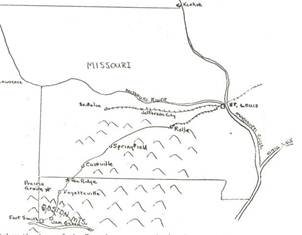 Fortunately for the men of the 19th Iowa, they remained at the
disease-ridden Benton Barracks less than a week before proceeding to Rolla,
Missouri. Probably they traveled south on the South West Branch Pacific
Railroad. If so, they were spared marching through interminable miles of rolling
red Missouri hills covered with scrub forests of small oaks and maples. But the
railroad ended at Rolla, and as many miles lay ahead of them as lay behind. They
transversed nother one hundred and fifty miles of uninhabited and useless Ozark
mountains, red and dry, by September 25th. As the forest opened to reveal the
beautiful valleys and fields of this corner of Missouri and Arkansas, the troops
must have breathed sighs of relief. The beauties of the Ozarks in early autumn
were, after all, the announcement of the annual death of nature, a reflection
congenial to that generation of mankind (and hardly to console soldiers fresh in
the field), and the barren mountains possibly concealed hostile armies.
Fortunately for the men of the 19th Iowa, they remained at the
disease-ridden Benton Barracks less than a week before proceeding to Rolla,
Missouri. Probably they traveled south on the South West Branch Pacific
Railroad. If so, they were spared marching through interminable miles of rolling
red Missouri hills covered with scrub forests of small oaks and maples. But the
railroad ended at Rolla, and as many miles lay ahead of them as lay behind. They
transversed nother one hundred and fifty miles of uninhabited and useless Ozark
mountains, red and dry, by September 25th. As the forest opened to reveal the
beautiful valleys and fields of this corner of Missouri and Arkansas, the troops
must have breathed sighs of relief. The beauties of the Ozarks in early autumn
were, after all, the announcement of the annual death of nature, a reflection
congenial to that generation of mankind (and hardly to console soldiers fresh in
the field), and the barren mountains possibly concealed hostile armies.
Springfield was a bustling young city,
the key to the southwestern frontier. The second battle of the war had been
fought here, to save Missouri for the Union. The 19th Iowa was
assigned to construct fortifications and to act as prison guards. These duties
were necessary, but amid these activities, combat training was somewhat
neglected.
The Iowans were to learn from experience.
In October the Army of the
Frontier was organized under General Herron with the duty of protecting the
western states from southern invasion and of occupying as much rebel territory
as possible. General Herron gave orders to march south. The weather was wet,
windy, and cold, the worst possible for a campaign in the Ozark mountains.
The first difficulty arose
at the Arkansas line. The Missouri militia units refused to march further south,
saying that they had enlisted for service in their own state only. The 20th
Wisconsin fixed bayonets and the 19th Iowa took up a position in the
rear of the militia and “the militia were given to understand they would have a
more relentless foe in their rear than front, if they refused to do their duty.”
A young member of the 19th described the march into Arkansas:
Our division then moved west into Benton County, Arkansas, and encamped on Sugar
Creek, to the right of Pea Ridge battle ground... Here we remained two days,
when, on Monday evening at dusk, October 20th, we again took up our line of
march. Slowly we moved out, at first on the main road, then bearing southwardly
until we struck the battle ground of Pea Ridge, which we crossed in silence at
midnight. Making a short pause at Elk Horn Tavern, (now rendered historic from
its location on the battlefield), we pushed on southeast, halting and resting an
hour before day-light, and then resuming the line of march. All day we pushed
our way down through the ravines and finally up a spur of the Ozark camps on the
banks of the White River. We had marched all night and all day without anything
to eat, and you may well imagine our appetites were keen. But you may take my
remark about “pitching camp,” as purely “sarcastical.” Not a tent was allowed to
be taken from the wagons, and only one hour in which to get supper and prepare a
day’s rations for the morrow. Of course, it was all that could possibly be done
to get enough cooked for our suppers. We then fell into line, an hour or two
after dark, marched down to the river, which was quite swift and deep, partly
stripped ourselves and forded it—It was a cold bath, but the men took it without
a word of complaint. It was a scene for an Artist’s pencil—that crossing the
White River at night. A huge fire on the opposite bank cast a glare over the
water, and lighted up the faces and bare limbs and glistening guns of the
soldiers, as with many a laugh and shout they stumbled their way across. Once
all over, large fires were built up, and from midnight till 4 o’clock we
shivered and slept around them. An hour then for breakfast, and just as day
began to break, we were on the way. Another long day’s march over rocky spurs
and down long ravines, where gurgling springs rushed out from the rocks to
refresh us, but with nary a sign of welcome from human face... An hour before
dark we stopped, got a hasty supper, and then, to the surprise of the army,
instead of going on to Huntsville, which we were near, we filled to the right
and marched hastily west. On we went, now pausing while the cavalry dashed to
the front, or to open the way for our battery wagons, occasionally making a
short halt for rest. About 2 o’clock at night we reached White River again, and
then rested till 5. This gave a chance for our trains to get up, and for the
poor, foot-sore, tired and worn out stragglers from the column also to catch up.
At daylight we started on without anything to eat, crossed the river again,
ascended the hill, and word came that the Rebels were several thousand strong a
few miles in front. A march of nearly ten miles, much of the way on
double-quick, brought us to the main road from Elk Horn to Fayetteville, about
13 miles below the former place. Here we were drawn up in line of battle—the 19th
Iowa on the left and the 20th Wisconsin on the right of our battery,
while the gallant 1st Calvary led a dashing charge down the road three or four
miles, scattering the rebels and causing them to make exceedingly fast time
toward Fayetteville...I venture to assert that no regiment from Iowa has done
more hard marching than we of the 19th, for the time we have been in
service. To resume, we marched three days and the greater part of three nights,
over the roughest roads in America, with only three hastily prepared meals
during the whole time—72 hours—and traveling upwards of a hundred miles.
Another volunteer wrote:
The 19th Iowa Infantry left Rolla, Mo. on the 16th say of
September, and since that time have marched 370 miles over mountainous
country...The 19th is a fine regiment of men, but to use them up in
this God-forsaken country by such marches and countermarches as they have been
performing is indeed a pity.
And it got worse, not better. It rained
for days on end, and the roads almost disappeared in mud. The baggage trains
were left far behind, the supplies did not arrive on time, and many nights were
spent cold, wet, and hungry with only the expectation of continuing the march
the next dreary morning.
On December 6, 1862, the Army of the
Frontier was a few miles southwest of Fayetteville, Arkansas, after a march of
one hundred and ten miles in three days through mountainous and heavily forested
country. As the long columns of troops neared the river, scouts saw Confederate
entrenchments covering a ridge on the opposite bank. General Herron drew away
the defenders’ attention with a feint and audaciously crossed the river and
formed his army opposite the enemy. Only then did the danger of the situation
become apparent. The Confederate force was four times the size of the attackers,
and the nearest Union brigade was ten miles distant. Nevertheless, relying on
his initiative, General Herron ordered an attack by the 19th Iowa and
the 20th Wisconsin. Ingersoll described the attack:
It was a grand sight. The batteries advances across the open field, belching
forth and smoke, and sending shell, and grape, and canister into the woods in
front as they moved up, and gallantly supported by the Nineteenth Iowa,
Lieutenant-Colonel McFarland, and the Twentieth Wisconsin. A rebel battery near
the edge of the hill, and a heavy force of infantry constantly fired on the
audacious brigade, thinning its ranks at every volley, but it pressed on
steadily and firmly till within a hundred paces of the base of the hill. There
the artillery halted and the infantry dashed ahead in one of the bravest charges
ever made. Moving across the rest of the open field with bayonets fixed, the
brave men of the Nineteenth Iowa and Twentieth Wisconsin rushed up the hill,
drove the infantry support from the battery, captured the guns, and moved on
against the enemy higher up the hill. Overpowered by numbers they were driven
back; but rallying under the cheering voice of McFarland they again attempted to
carry the position, but were again overwhelmed by numbers and compelled to
retire, but not till the undaunted McFarland and hundreds of his gallant
comrades had fallen on that fatal field. It was as brave a fight as men ever
made, but here it did not avail.
The battle raged back and forth all day.
Union reinforcement saved the army from disaster, and nightfall brought an end
to the carnage. In the dark the Confederates, still outnumbering the Union
forces three to one, slipped away, leaving over one thousand bodies on the
battlefield. In the morning the Unionists counted over one thousand casualties
of their own, of whom one hundred and eighty-seven were dead. E.B. Doane’s
Company was hard hit, and his brother Ithamar was wounded in the shoulder.
Official reports were enthusiastic:
I cannot speak too highly of the gallant conduct of the officers and men of the
Nineteenth Iowa, for after being repulsed with great loss by an overwhelming
force of the enemy, they rallied and brought from the field the colors of the
Twentieth Wisconsin Regiment. Captain (S.F.) Roderick, of the Nineteenth Iowa,
deserves special mention for his meritorious conduct. He gathered together some
70 men of his regiment, after it was broken and scattered; rallied them around
the regimental colors, and, under my direction, formed them to the left of the
Ninety-fourth Illinois, where they did good service, and only retired from the
field when ordered to fall back. Lieut. Richard Root, acting adjutant of the
regiment, is also entitled to honorable mention. By direction of his commanding
officer, and at the request of his captains, he took command of three companies
of skirmishers, and maneuvered them with great bravery and skill.
It can be assumed that E.B. Doane
fought under his immediate superior, Lieut. Root.
Once recovered from the fighting, the 19th
Iowa resumed the advance. E.B. Doane was with the regiment December 28th,
when it captured Van Buren, Arkansas.
The Confederates had hoped that the mountains themselves would defend this
highly strategic point where the Arkansas River breaks into the Ozarks right on
the edge of the Indian Territory. It controlled the route from southwest
Missouri into Texas and access to the Indians, whose alliance was desired by
both North and South. But in a long night march the 19th Iowa crossed
the rugged Boston Mountains and occupied Van Buren. By the 31st the
unit had returned to Prairie Grove, where Gen. Schofield reviewed the troops on
January 2nd.
On January 3, 1863, Sergeant E.B. Doane
was detached from Co. K of the 19th Iowa infantry on recruiting duty,
and returned to Iowa in company with his friend and commander, Lt. Richard Root.
They reported to Capt. Hendershot, the Superintendent of the Recruiting Service
in Iowa, and were assigned to a small town in Henry County, New London. They set
up their recruiting station in Perry Frank’s Boot and Shoe Store, but presumably
they also traveled around seeking out enlistees. They advertised:
Best and Bravest Regiment in the Field...
One months pay and $25 of the $100 in advance.
Anyone bringing in a recruit will receive a premium of two dollars.
In May they were reassigned by
the new Superintendent to Mount Pleasant, where they established their post in
the Brazelton House.
Without doubt, recruiting
duty allowed both men opportunity to visit friends and family, and even to do
some “sparking.” E.B. Doane took advantage of his opportunities. He must have
made many trips down into Lee County to court Miss Amelia Cahill. Certainly, on
the Fourth of July he escorted Amelia to the Independence Day Celebration. This
was traditionally the biggest holiday of the year, and the war made it even
larger. Everyone went to the Fair. And that evening she accepted his offer of
marriage.
However, marriage had to
wait. When Lt. Root and Sergeant Doane were offered commissions in a new cavalry
unit being formed, they accepted with alacrity. Soon thereafter, on August 1st,
Special Order 105 discharged them from the 19th Iowa so they could
concentrate on recruiting men. Already they had signed up a number of men from
Henry County, the first on July 4th; now Captain Root and First
Lieutenant Doane hurried to fill the ranks of Company E, 8th Iowa
Volunteer Cavalry.
As commander of this new
regiment the Secretary of War chose Lieutenant Joseph B. Dorr. Dorr had been a
noted Democratic editor in Dubuque, and in the presidential campaign of 1860
Stephen Douglas had written the “Dorr Letter” to him. He had volunteered for the
first units organized, had accepted a minor commission, fought bravely at
Shiloh, and escaped from prison camp. So many volunteers flocked to join his
unit that many had to be sent to other regiments. Many veterans such as E.B.
Doane were advanced to officer rank, and new equipment issued, so that the 8th
Iowa was considered one of the finest regiments ever raised in the state.
It was not long before he wrote home:
Dear Father, Brother, and Sister,
I arrived here safe this morning. Everything is all right. The order to muster
me out for Promotion has come from the war department and I will probably be
mustered out tomorrow. I was ordered to take command of the company this
morning. Mendenhall has been thrown out and Charles Sanderson from Keokuk of the
9th Iowa Infantry is 2nd Lieut. of the Co. Lieut. Anderson is acting
Adjutant of the Regt and I have all the Responsibility of the Co. to face alone.
Capt. Root is here but can’t take command yet. But will soon take the command of
a Battalion as Major. The Boys are mostly well, none in the hospital. Orderly
Durham I understand he is pretty sick. I haven’t seen him yet.
Father I want you to take charge of my corn and I hereby authorize you to do so
and to sell it. Do just whatever you think best under the circumstances. If the
affair can be settled honorably by letting P. John have the corn, all
right, and if he attempts to make trouble about it, I want you to enter suit
against him for the corn he has taken and Garnish the money in King’s hands for
the pay or the corn and the maintenance of the suit. But if he will come up and
act the man and do me justice, give him a chance and if not take the start of
him in the suit. See King and so the best you can and see that Patterson gets
the money that I failed to get in Salem. If it can’t be had there in a week
write and let me know and I will send it down from here. Write soon and let me
know how things are prospering about that corn. Prince is all right. I got along
finely with him on the Boat. He made friends of all the sick hands on the Boat.
No more at Present, but remain as ever yours.
E.B. Doane.
This letter indicates that
young Lieutenant Doane was very much a man of his era—eager, ambitious, somewhat
quarrelsome, and sentimental, particularly over his horse, who was a pet, not a
beast of burden. His proposed lawsuit further shows how little Quaker principles
affected him—Friends did not enter suits at law.
The regiment was mustered
at Camp Hendershott in Davenport on September 30, 1863, and transported to
Louisville, Kentucky, on October 17-21. It was his first experience in command
of a company. Capt. Root was absent Oct. 16-31st, and E.B. Doane replaced him
without difficulties of any kind.
On November 4th the 8th Iowa
began the march south to Nashville, a journey of almost two weeks through
country badly devastated by war.
They were to escort a heavy forage train and the First Kansas battery (old
comrades-in-arms from Prairie Grove battlefield). All were in fine spirits.
Indeed, some had too many spirits and were more than mildly intoxicated. As it
happened, the Quartermaster of the 8th Iowa become a little drowsy
and decide to take a short nap just off the road. Unfortunately for him, he did
not awake before the last wagons and the rear guard had passed far down the
dusty road. His first sight on regaining his faculties was of a tough and ragged
group of Confederate guerrillas who had been trailing the Union force and had
spotted him dozing in the grass. They stripped him of weapons and clothing,
brought out a rope and threatened to hang him unless he told them about the
unit’s strength and destination. After he told them what they wanted, they
turned him loose, naked and horseless, to make his way to the camp. Captain Root
joked, “We had quite a gay time over his returning in the plight he was.”
Later, some persons objected to the veracity of this account, but Captain Root
affirmed that it was the truth, and accompanied his letter with an affidavit
signed by several officers, among whom was E.B. Doane.
Late in November the unit received its carbines,
so the men expected to join the main army immediately. Instead, the 8th
Iowa was assigned to guard the communication lines west of Nashville. This was
an important and dangerous duty, but hardly glamorous. Without doubt, the men
grumbled. Wars, however, are not won by raw courage alone. Food, ammunition,
medicine must be available to the troops at all times and in spite of all
difficulties. Hundreds of thousands of men labored to bring supplies to the
battlefront. Every case of biscuits, every canister of shot was loaded and
unloaded onto a succession of wagons, steamers, trains and mules until it
arrived at its destination hundreds of miles away, perhaps unusable because of
mishandling somewhere along the line. The problem of bringing supplies to the
Army of the Cumberland at Chattanooga was almost insuperable. Major battles had
been fought at Shiloh and Corinth to occupy the lower reaches of the Tennessee
River, but farther up it remained closed to steamers. That left the rail line,
which was fairly safe south of Nashville, thanks to the large numbers of Union
troops; to the north, however, on the Louisville and Nashville R. R.,
Confederate guerrilla forces had almost halted traffic. That would not be
serious if the Cumberland River had been navigable year around, but low water
made the Harpeth shoals and other points impassible. If the army at Chattanooga
was to be supplied, a new route had to be opened. Army engineers chose to finish
a spur of the Memphis-Nashville railroad from Nashville to Waverly and add a
short to a landing on the Tennessee River at Johnsonville. This allowed supplies
to be shipped from Paducah to Johnsonville by steamer, and then loaded onto
trains and sent to the great arsenals at Nashville for trans-shipment south. Of
course, this attracted Confederate attention. When guerrillas and even regular
Rebel units began to raid the line, the Eighth Iowa was stationed there to
protect it.
Col. Dorr divided his command, placing the three battalions approximately thirty
miles apart along the railway. He broke up the First Kansas Battery among the
battalions, two guns to each, for additional firepower. E.B.
Doane’s 2nd battalion was stationed thirty miles west of Nashville. Most
attention, however, was centered on Waverly, where Col. Dorr established his
headquarters.
One cavalryman wrote home:
Our battalion (the 1st) have invited themselves to spend some time,
perhaps the winter, with the good people of this place. If our sensibilities had
not been blunted by soldiering we might have thought we were not very welcome
guests, for our reception was not very cordial. They used very abusive epithet
to the men; said we had just come to plunder them and destroy their property,
and that their gallant defenders would not permit us to hold the town many days.
By the way, the only manifestation of the presence of the aforesaid “gallant
defenders” we have had is when under the cover of darkness they have concealed
themselves and fired on our pickets, but we wouldn’t take the hint, and
we stayed.
This is the county seat of Humphies County, and at the commencement of the war
was in flourishing condition, but like every other Southern town, is reaping the
fruit of secession... There has never been any Union troops here before, and the
inhabitants have very appropriately named it the “Rebel Heaven”. Here they have
met and organized their plundering expeditions with perfect safety, for there
were no Federal troops closer than Fort Donelson, and when forced to retreat
from other parts of the State, have come here for protection... Almost daily
Col. Dorr has companies out scouring the country in all direction. The good
results of this system are already manifesting themselves. Every day the town is
crowded with citizens. Nothing more is required of those who have never aided
the rebellion than taking the oath, but the others are placed under heavy bond,
and as they all have property in this immediate vicinity, their bonds can be
depended upon.
Because of the constant patrolling and the large number of guerrilla
forces, it was not long before E.B. Doane saw combat. His commander, Captain
Root, described a “picket fight we had on the 7th in”.
It having been ascertained by an intelligent contraband that came into camp
about 5 o’clock on the 7th, that there was a band of guerrillas
hovering around our camp, it being too late in the day to send a force (sic) out
after them, Maj. Thompson in command, concluded to strengthen the outposts and
keep a sharp lookout for them. Orders were given for every man to sleep on his
arms, to be ready in case of attack. Sure enough just about eleven o’clock Post
No. 1 and No. 2 were attacked by a superior force. It being dark it was very
hard to tell their number. Receiving orders to ascertain the strength of the
enemy if possible, I rode to Post No. 2 ,as the fighting appeared to be the
heaviest at that Post. It soon became apparent that their intention was to
destroy the railroad. Having ordered 25 men to dismount, they were thrown
forward, when a general fight ensued for two or three hours. The rebels having
superior numbers drove us across the railroad. Then with a dash we would drive
them back, keeping the road clear. It being too hot for them after trying at
three different points to destroy the tracks and failing to do so, they beat a
hasty retreat, carrying off their wounded, leaving their dead on the field.
Casualties on our side, Lt. E.B. Doane, flesh wound in the face, slight...Lt.
Doane was the officer of the guard or picket, and was at Post No. 2, where the
fighting commenced and it was through his daring and bravery that the Post was
held until reinforced...
E.B. Doane wrote to the Keokuk editor:
Mr. J.B. Howell,
If agreeable with you, I propose through your columns to inform the home friends
of Co. E, of a little Christmas scout we have been having after some of our
guerilla friends. We were out five days, subsisting both men and horses off the
wealthy secesh farmers pointed out to us by our guide, and we fared well too.
Our scout was in the direction of the Tennessee river, principally on the waters
of the Piny and Duck rivers. We had one engagement resulting in the rout of the
noted Col. Hawkins and staff, the capture of four Captains and nine men, one man
killed and another (like the swine of which we read,)
ran down into the river and drowned. The enemy brought on the engagement by
firing from ambuscade a volley into the front of our columns, shooting Captain
Root through the hat, which they supposed would check our advance until by a
running fight and the speed of their horses they could escape. But they found to
their sorrow that it took more than a volley of revolver shot to check Captain
Root and his column. I can hardly believe a volley of grape and canister would
have done it. For every one charged directly upon them, yelling like so many
demons. Those guerrillas are choice men, mounted on number one horses and armed
to the teeth. Their business is to plunder and abuse Union citizens and harass
our advance by dashes and daring raids, and destroying bridges, railroads and
supply trains. And it is only by constant and rapid scouting that they can be
kept out.
For a week past we have been visited with snow and cold weather. But prior to
that it had been remarkably warm and rainy. The health of the Company is good,
and the entire Regiment seems to be blest in this particular. Deserters are
coming in almost daily. The late Proclamation of Amnesty by the President will
take half the men out of the rebel ranks, especially near the front. We have
reliable information that the enemy can no longer depend on a picket, which is
certainly a bold indication that they are fast playing out. As fast as the main
line is moved to the front the railroad is being pushed forward too, principally
by black labor. Thus, instead of “Sambo” supporting the rebel army, he is
helping get it forward to us.
Respectfully,
E.B.D.
One Kansan stationed with E.B. Doane’s battalion described the miserable
weather:
The winter of 1863-’64 was noted as a cold one, breaking all records. The little
creek known as Sullivans Branch, twenty-six miles from Nashville, upon which we
camped, was frozen almost solid. At this camp, although in daily communication
by rail with the great depots of supplies at Nashville, we suffered the greatest
hardship experienced during our entire army life, because of the villainous
character of the rations furnished us. These rations consisted solely of salt
pork—the lean streaks between the solid fat portions having in many instances
turned green-hard-tack, sugar and coffee. In consequences of this meager diet I
acquired a severe attack of scurvy...
In such scattered fights, the 8th Iowa captured over five hundred
guerrillas.
But it was difficult and tedious warfare.
The winter was severe and supplies were scarce, and there was no decisive
fighting because each army was preparing for the renewal of offensive operations
in the spring.
Men were tired and lonesome. E.B. Doane wrote:
Dearest Amelia:
(For to me you are certainly the Dearest on earth). Your very acceptable
letter was received today and it did more good than anything I have seen or read
since I have been out. It found way to hidden affection, that I knew not of and
if I loved you before, I cherish and almost adore you now as the hope of
my coming happiness.
The prayer and affection of a Christian Lady to the mind, affection and
character of a lonely Soldier is like the soft distilling dew or a gentle shower
of rain to the drooping bud. With regard to my affectionate heart perhaps I
would have had an affectionate one if those finer feelings had been cultivated
as they should have been when I was younger. But I feel that they were blighted
in the loss of a tender mother when I was quite young, hence with no one to
nourish and cherish those finer senses they remained a mere-------until I was
old and large enough to begin to think about loving some one as partner for
life. And now I feel (as doubtless you have noticed ere this) that I greatly
need those feelings nourished and cherished by some faithful and affectionate
friend. Yet as far as my feelings of affection extend, you shall enjoy with
pleasure to me. I received a letter from a certain young lady
who stated that she was at the festival at Sharon Church and saw my old lover
there. I also had a letter from Mr. Maris hinting as though he wanted to know
something. My Health is better. Health is generally good and the weathers fine.
Farmers are ploughing. This State holds an election next week to reorganize the
State Government. The Army at the Front is advancing and I expect we’ll go there
soon. Wish I had been home as you heard. I will come if (I) can. But don’t look
until you see me coming. That is a nice rose. I’ll keep it as a token of love
from a Dear one. I said I was better, but I am Love sick and I expect
that will make me homesick. I really feel that I am blest in having such
a Friend as you to write me such good kind letters. I am
glad they held the Meeting and had the dinner at the Church. If a Meeting
indicative of Friendship and regard for the Soldiers who
are fighting not only for the preservation of our Government but
in defense of Religious liberty and the right of a free
people to Govern themselves is not worthy of a place in the
Altar even of Paradise, then we had better sheath the Sword and prepare
for an Eternal abode in Despair. If there is anything I
detest it is a base Copperhead that’s too mean to protect
the country that has protected him and really made him what he
is and gives him the positions he now holds and too
cowardly to go and fight for what he advocates. Oh, But there
is a time coming when such men will wish to God this had been a
blank in their lives. I have more respect for the Enemy who meets me
in deadly conflict than one of those white livered fellows. But
I’ve said too much on this, yet I feel it and if I had my way they would have to
leave the country for want of associates.
When I come home we’ll have a nice horseback ride. Your little Horse looks fine.
I don’t ride him much. It’s too nice to kill up in this country. I shall have to
close. Its time for dress parade, with many warm wishes for your comfort and
enjoyment and hoping to hear from you... I remain your true and sincere friend.
E.B.Doane
Unknown to him, his brother Ithamar had died just the day before. Ithamar, a
year younger than Eleazar, had remained in the 19th Iowa Infantry,
which had taken part in the siege at Vicksburg, and then gone on to New Orleans.
Sometime that summer he fell ill, and on September 8, 1863, he wrote home that
he was in the regimental hospital: “I am quite weak but able to walk about the
house some and sit up about half the day. I have had the Diareah nearly all the
time since I came down the River and then I took the Fever. It has been the
hardest spell I ever had...There is still a good deal of sickness here.” Several
months later, the entire time spent languishing in the hospital, he was
furloughed home. The trip was too exhausting, however, and he died in Salem,
Iowa, February 25, 1864, one week after his return. The medical report listed
cause of death as chronic diarrhea. Eleazar would learn of Ithamar’s fate within
a few weeks. The news could only have increased his hatred of the South’s
rebellion.
However passionately one may grieve, one cannot exist on hatred, and the Iowa
cavalrymen were kept busy to prevent their brooding on death. What did the
troops of the 8th Iowa do? The same as in any army: real and
artificial business (drills, scouting, guard duty), reading papers, writing
letters, and talking. Politics was an impassioned subject. Captain Root wrote
home:
I see by the papers that the Presidential campaign has fairly commenced-all the
soldiers ask for is for the Union party at home to stand by OLD ABE, as we think
he is the man, and the only man to place in the Presidential chair at this
critical time. But let it be Lincoln or any other man, all we want is a man that
will carry out the present policy of the government, and woe be to that man or
party that dare say peace till the proud flag of our country floats over every
rebel strong-hold, and those miserable traitors that have been the means of all
this unholy war suffer to the fullest extent for their crimes.
His attitude was undoubtedly shared by E.B. Doane.
Early in March General Grant was promoted to command all the armies of the North
and left for the east. General William Tecumseh Sherman assumed command of the
Army of the West with orders to press on to Atlanta against Johnston’s
Confederate forces. To relieve the overworked supply system, the Union forces
stripped themselves of all but the most necessary gear and reassembled at
Chattanooga and Cleveland prepared to press south along the rail lines toward
the Confederate position at Dalton. E.B. Doane’s unit rode to Nashville on March
14 and was assigned to McCook’s First Cavalry Division. The duties of the
cavalry were to provide a screen along the front and flanks of the advance and
to disrupt the enemy position as much as possible. Over one-hundred thousand men
began to move south.
E.B. Doane saw this as an opportunity for advancement. On April 5th he had been
promoted to Captain of Co. E.
He wrote to his fiancée:
Dearest Amelia,
Tonight I was favored with your highly
prized Epistle of the 30th. I was truly glad to hear from you, for I think of
you often, quite anxiously too. I wish I could interest you better, but I am
tired and in a hurry, and can’t write much this time. We have been on the March
ten days and will go on to Cleveland 30 miles east of here. We are camped at the
foot of Missionary Ridge over which the Battle was fought. Today we crossed the
front of Lookout Mountain. We have been rained on every day since we left
Nashville and have had a very rough road. The road across the Cumberland
Mountains was so hard that we walked and led our horses and then walked back and
carried our things that were in the wagons. Three of our wagons were broken to
pieces crossing. There are a number of troops coming to the front now and I
expect something is to be done soon. The enemy is in line about 20 miles from
here. But if they couldn’t hold the position they had here, I don’t think they
can any other. I send you Lt. Anderson’s photograph. He is 2nd Lt. of
our Co. and I’ll send one of Capt. Root’s if I can get it. Give mother & father
my respects & to the rest of the family too, and tell Mary Jane I’ll bring her a
Bear again on the 4th of July. I guess I’ll hardly forget that Exhibition or
that night or the one I was with soon either.
I’m sure your letters are not lacking in interest. I’m glad you are enjoying
yourself so well. I hope the time not far distant when I can see you again,
Dear. I am well. Capt. Welder has returned. Please write soon and accept the
warmest wishes of your Friend and Lover,
E. B. Doane
There had been some illness and some dissension among the officers regarding
discipline, which resulted in the resignation of several officers of the Eighth
Iowa,
but neither the efficiency not the morale of the unit was seriously affected.
One cavalryman wrote home:
We had quite a gay time on the road from Nashville. The roads were very bad, and
would have been considered impassible for anything but a Government train, which
may go through, though at the sacrifice of the lives of many animals. I don’t
think I would be exaggerating to say that I saw the bodies of two thousand dead
horses and mules on the road.
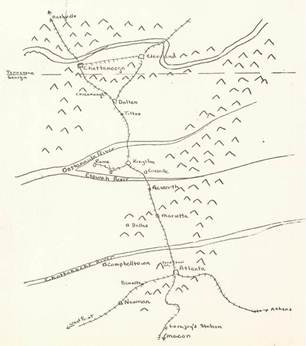
From May 7, 1864,
the day Sherman began his offensive into Georgia, to July 30th, the 8th
Iowa was in continual combat.
On May 9th Col Dorr led Company E up a steep, open field to determine where the
enemy lay; only the Confederates firing high saved the unit from heavy
casualties; every day thereafter the Iowa men were involved in a running fight
with Confederate cavalry while screening Sherman’s march across some difficult
mountain terrain toward Dalton. This outflanking maneuver forced the
Confederates to pull back across the Oostanaula River. Sherman then outflanked
the defensive positions there as well. As Sherman pressed south through the
mountainous and unmarked country into the relatively open land north of the
Etowah, he scattered his troops along several lines of advance, looking for
Confederate weak points. Although this seemed risky, tempting his opponent to
stage an ambush or counter-offensive, Sherman could rely on his experienced
commanders to exercise a combination of boldness and caution which had appeared
only rarely earlier in the war. By now the Union officers were proficient in
their performance of duty; moreover, unlike many officers in the Army of the
Potomac, they were accustomed to victory and, therefore, confident in their
ability to carry out the most difficult and hazardous of assignments. Sherman
was seeking a fight. The opposing commander, General Johnston, in contrast, was
determined to avoid any engagement which did not promise a major victory at
relative low risk. He could not afford to have his army worn down by repeated
battles, as Lee was
 experiencing
against Grant; he had to preserve his troops for that moment when Sherman made a
mistake, or until Sherman’s supply lines became so long that most of his troops
were tied down protecting them. Nevertheless, he knew that his army’s morale was
suffering from the repeated retreats. At Cassville, tempted by Sherman’s
provocative and aggressive advances, Johnston sought to destroy one wing of the
Union army by concentrating his entire force against it. No decisive battle took
place, but there was a spirited engagement with Union cavalry. The 8th
Iowa and Major Root were cited for distinguished conduct in their charge upon
the Confederate flank. The next day Johnston withdrew further south and the
Union troops occupied the abandoned trenches.
experiencing
against Grant; he had to preserve his troops for that moment when Sherman made a
mistake, or until Sherman’s supply lines became so long that most of his troops
were tied down protecting them. Nevertheless, he knew that his army’s morale was
suffering from the repeated retreats. At Cassville, tempted by Sherman’s
provocative and aggressive advances, Johnston sought to destroy one wing of the
Union army by concentrating his entire force against it. No decisive battle took
place, but there was a spirited engagement with Union cavalry. The 8th
Iowa and Major Root were cited for distinguished conduct in their charge upon
the Confederate flank. The next day Johnston withdrew further south and the
Union troops occupied the abandoned trenches.
By now the respective strategies of the two commanders was clear. Sherman wanted
a battle in the open so as to destroy the Confederate army. But he would not
assault prepared positions. That would be an unimaginative use of his
superiority in manpower, probably too costly, and most likely ineffective.
Instead, whenever he encountered trenches, he would have some troops dig in
opposite, so that the Confederates would have to be ready to meet a direct
assault; with the rest of his army he would move laterally, outflank the fixed
positions and force the enemy to choose between a pitched battle on open land or
retreat. Johnston, on the other hand, had too few troops to fight that kind of
battle. Each time he was faced with such a choice, he retreated, hoping the
extended northern supply lines would require more garrison troops and reduce
ever more the actual combat forces opposed to him. Meanwhile, he was gathering
reinforcements; although he soon had almost as many men as Sherman, his North
Georgia militiamen were relatively untrained, often pro-Union, and prone to
desertion. At every strong point Johnston prepared elaborate defenses, such as
could bleed Sherman’s forces to death if he attacked head-on. From Cassville
Johnson fell back to Marietta, where he prepared to make another stand along the
railroad line.
On May 22nd Sherman began to outflanked the Marietta trenches by moving overland
toward Dallas, with each man carrying his own rations and equipment; he sent the
cavalry ahead, McCook’s division (and the 8th Iowa) in the lead. Two
days later E. B. Doane’s unit charged and routed a superior force at Burnt
Hickory. The following day, May 25th, there was a sharp combat at New Hope
Church near Dallas. There Lt. Anderson took a rebel battery and held it several
hours against desperate counterattacks before being ordered to withdraw.
Both armies then entrenched themselves. These defensive works were constructed
on these principles:
The
general...determined the most available line for defense, and directed brigade
commanders to form their troops upon it, following the outline of the ground and
making such angles, salient or re-entrant as it required. The
skirmish line was kept in front, the rest stacked arms a few paces in rear of
the intended place for the breastwork, entrenching tools were taken from the
wagons that accompanied the ammunition train, and each company was ordered to
cover its own front. Trees were felled and trimmed, and the logs, often two feet
thick, rolled into line. The timber revetment was usually four feet high, and
the earth thrown from the ditch in front varied in thickness according to the
exposure.
The Eighth Iowa
held a line one and one-half miles in length until July 1.
But E. B. Doane was not present when the army moved south again. The cause of
most fatalities in the war was not battle, but disease. Epidemics ran through
entire armies and hospital facilities was completely inadequate. On June 20th E.
B. Doane was overcome by illness. He relinquished his command, but remained with
his company until ordered to the hospital by the surgeon. He was taken to
Ackworth, Georgia, and three or four days later was evacuated along the railroad
to an Officers Hospital in Nashville.
Miss Amelia:
Dearest Friend. Today I feel better and more like writing you. But I can’t write
a good letter yet. I’ve been improving considerably. Yesterday I rode (in a
carriage) down town, but it was a big job. The weather is quite warm. I wish I
could get a leave of absence a few days when I get stronger. Which I may do. But
I think it uncertain. But it won’t be my fault if I don’t. I’ve had no mail
since I came here. I shall look anxiously for a letter from you in few days. I
expect there’s some at the Regt. I have sent for it. But it may be sometime
before it come and it may not come at all.
We still have encouraging news from the front. I’m so sorry that I’m sick now
when there is such a good chance to distinguish ones self and gain a better
position. If I could have had good health and come through this campaign safe I
would have made a Field Officer easily. You need not be surprised if I get it
anyway. I’ve worked hard for it and ran a great many narrow risks. I know I’ve
earned it well. And if they don’t promote me to it soon, I guess I’ll come home
to my Amelia Dear!! Will that be right? There are wounded and sick coming
in every day from the front. Several of my co. are in the Hospital back about
town wounded and some severely, too. But I’ve been unable to go and see them
yet. I think I shall try it soon though.
I learn that Mrs. Spurries, an old Schoolmate of mine and classmate too (at Mr.
Howes) is teaching at Primrose. Have you become acquainted with her yet? She was
(portion damaged) to a soldier home on Recruiting Service. He too is a
schoolmate of mine. He is in the 14th Infty. I still get a letter from Mr. Maris
occasionally. He likes to talk Patriotism better that act it, I
think. How do you enjoy your school? Are you going to have a fine celebration on
the 4th? The Potomac Army is to celebrate the 4th in Richmond and the Georgia
Army in Atlanta. I wish I could help do it. And the next 4th with (portion
damaged). Won’t that be nice? Please write soon. Direct to Capt. E. B. Doane,
Officers Hospital, Nashville, Tenn., leaving off the Co. and Regt. or else it
will go on to the Regt. With many warm wishes for your enjoyment and well being
I bid you Good Bye.
Your Affectionate Friend
E. B. Doane
A month later he was still in Nashville, but he was much healthier. He wrote
home:
Dear Brother and Sister,
Today I received your welcome and interesting letter of the 10th & 13th
Inst. I was truly pleased to hear from you and to know that you were well. I
would indeed like to come home for awhile and if I had known that I would not
have been able for duty before this I should have come. But now I shall go to
the Front soon, in about a week I think. I am not well, but I won’t live here. I
am better though, and think by taking good care of myself I’ll get along.
Governor Stone was here today and will go to the Front soon.
Perhaps I’ll go down with him. I’m glad that money got through safe. I sent 100
dollars more. It was a check on New York Bank. I sent it in a letter. Please
write as soon as you get it for I’m uneasy about it. If it’s lost I can get
another one here before I leave. When you write again tell me how much corn and
so forth you had and whether all the farm was cultivated or not. I’ve only had
one or two letters from you yet. I expect that others are at the Regt. Capt.
Hoxie of the 8th was married here today. His Lady came from Vermont.
I was at the wedding. I had a letter from Franklin today. He is well and at
Kingston, Ga. and says my horses are doing well. Is your school a good one and
what do you study? Try and go all you can and every day this winter. Please
write soon and often direct as before until I write to change it. Tell Father to
write soon. Give my respects to all.
Meanwhile, Sherman had moved past the strong Confederate positions at Marietta
and Kenesaw Mountain, forcing Johnston to withdraw across the Chattahoochee
River. The 8th Iowa was the first cavalry unit to cross the river in
pursuit.
Sherman planned to continue his advance south by outflanking the carefully
prepared entrenchments, just as he had done before. This time, however, he faced
a new enemy commander, John Bell Hood. The Confederate high command, believing
that Johnston’s tactics were too cautious, replaced him with a true fighting
general. Hood, who had lost at arm at Gettysburg and a leg at Chickamauga, was
an impulsive gambler. He quickly launched a series of desperate attacks against
the Union line. The 8th Iowa position was assaulted on July 23rd
and 27th, about the time E. B. Doane returned.
Hood’s costly attacks so weakened his army that the Confederation high command
reinstated Johnston in command. Sherman quickly resumed his flanking movements,
forcing Johnston to commit so many troops to permanent defenses that he would
either spread too thin to hold the center or would have to fight to avoid being
surrounded. He hen ordered General McCook to make a deep raid into Johnston’s
rear, disrupting communications and drawing troops away from Atlanta.
One member of Company E described the raid:
Our regiment numbering tow hundred and
ninety men, (the remainder being dismounted and in camp at Kingston, Ga.), in
company with the remainder of our division, started on the 27th
ultimo to make a raid through central Georgia.
We crossed the Chattahoochee River to
the west side and moved down about twenty miles, to Cameltown. We recrossed the
river on the morning of the 28th and struck the Atlanta and West
Point Railroad, at Palmetto Station—We destroyed several miles of the road at
this place, after which we pushed forward with great rapidity toward the Atlanta
and Macon road, which we reached on the morning of the 29th;
destroying while en route, over eight hundred wagons loaded with Government
Stores—The mules were sabered, as we were unable to take them with the command.
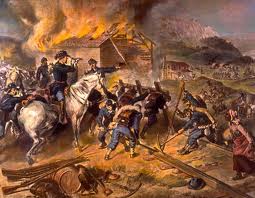
On arriving at McDonald’s Station on the
railroad, Major Root was ordered out with a portion of the 8th Iowa,
and succeeded in capturing and burning a train loaded with Tobacco, Lard and
Arms.—The tobacco alone was estimated at one hundred and twenty thousand
dollars.—After effectually destroying several miles of the road, the command
proceeded to return.
When but a short distance from the road
our column was attacked by a heavy force of rebel cavalry, and the 1st brigade
was entirely cut off. Major Root was ordered to take the 8th Iowa and
charge to open communications.
The men charged with revolvers, and a
desperate hand to hand fight ensued, but they were finally driven back.
Twice they charged, and twice were they
pushed back, by an overwhelming force. The Major’s horse was killed in the first
charge, and he received a severe injury in his right shoulder, nevertheless he
was not found wanting when the second charge was to be made.
General McCook came up with the 2nd
brigade, and succeeded in cutting thro’ and the command moved rapidly toward the
river, and reached Newman’s Station on the morning of the 30th. Here the 4th
Ky. was attacked and two companies were captured. We soon found that the enemy
had a heavy force in our front and on our flanks. The division was halted and
the forces so disposed as to deceive the enemy. Our regiment was ordered as
skirmishers and to discover the position and strength of the enemy; we found the
enemy endeavoring to surround our force; his line at that time running in the
shape of a horse-shoe, the opening being toward the south, and that their forces
consisted of cavalry and two brigades of infantry. The engagement soon became
general along our whole line; the enemy making repeated charges, and were as
often repulsed.
Major Root was then ordered to mount his
command, and charge down the road leading to the river. He moved his command
back and advanced cautiously down the road until within sight of the enemy, and
then ordered a charge. The boys soon found themselves confronted by Ross’s
brigade of Texas Rangers; but nothing daunted, they dashed into their lines and
drove them back, compelling then to abandon their horses, as they were
dismounted at the time, and captured over five hundred horses, and finally
succeeded in clearing the road; but they were closely pressed by superior
numbers, and the Major dispatched three different orderlies for reinforcements,
but not one got through. Seeing that his command was being cut off, the Maj.
ordered the men to cut their way back. In doing so the Maj. with two
commissioned officers and ten men were cut off and captured, but seeing a party
under Gen. McCook forcing their way out, and not relishing the prospects of
sharing a Southern prison during the remainder of the summer, they made a sudden
dash and escaped from their captors...Only sixteen of our regiment have come in
to this date—the remainder have undoubtedly been killed or taken prisoners.
J.B. Downer reported the combat, too:
After nearly two days of hard fighting
in which our regiment was continually engaged and much of that time in close
hand to hand combat, we were overpowered, surrounded by superior force and most
of the men and officers then present captured. Too much praise cannot be awarded
to our brave and gallant Colonel, who being wounded in the first days fight did
not leave his saddle, but still continued to lead and urge his men forward, and
though afterward confined to the ambulance, he again took his horse the second
day and staid (sic) with his men. The fight was sharp and spirited as we were
fighting Texas rangers; the best and most daring soldiers of the South, who all
admitted that they never saw such cavalry fighting nor such determined charges.
Many of our men fell but we think many more of theirs. After being captured we
were taken to Andersonville prison some sixty miles south of Macon….
E. B. Doane had commanded his company for five days and nights without sleep.
Colonel Dorr wrote:
n this engagement, which was of the severest character, the men and officers of
the English behaved with a gallantry and steadiness which drew from General
McCook a public compliment on the battlefield. As on the days before there will
be few exceptions to this, while there were many instances of great gallantry
displayed. Major John H. Isett, Captain P. C. Morhiser, Captain (now Major)
Shotry, who was desperately wounded, Captain James W. Moore, Captain E. B.
Doane...are fairly entitled to mention for coolness and good conduct under very
trying circumstances.
General McCook said, “Whatever of disaster occurred was by the inevitable
fortune of war or chargeable to some other bond, and was not for want of
fidelity or gallantry on the post of the officers or men under my command.
E. B. Doane wrote home as soon as he could:
Dear Friend Amelia,
I, with almost the entire mounted portion of the Regt. was captured on the 30th
after three desperate charges, suffered severely. Twenty of my Co. are prisoner,
two wounded, and three missing. Both of my Lts. are prisoner & Lt. Reese
wounded. Col. Dorr is wounded and a prisoner. Maj. Root I think escaped. I feel
pretty well as far as health is concerned. We expect to be sent to Charleston or
Savannah tomorrow. Please direct to me a Prisoner of War at Savannah with this
stamp on it, directed to Commissioner of Exchange, Fortress Monroe, Va., For
Flag of Truce. We can’t write much. With many warm wishes for your enjoyment and
well being. I am truly your Friend.
E. B. Doane, Capt. Co. C, 8th Iowa Cav.
The next day he wrote again:
Dear Friend Amelia,
We arrived here this morning (—was seized) for Exchange. But I have little faith
in it yet while not much before Christmas, although it may be in a few days.
Nearly all the mounted part of the Regt. was captured on the 30th
after losing severely and being entirely cut off. Col. Dorr is wounded & a Pris.
Maj. Root I think escaped. I have one Lt. and two men wounded & pris. Two men
missing, one Lt. (I believe), 18 well men Pris. I am feeling quite well now.
Hope I may still be blessed in that respect for disease is all that I fear at
present. Although confinement is by no means pleasant. Capt Walders and I occupy
one room 6 and 8 ft. & the privilege of a hall & walk way in the day time.
Please direct to me a Pris. of War at this place with this stamp on it inside, &
inclose it in another envelope with a U. S. stamp on it directed to Commissioner
of Exchange, Fortress Monroe, for Flag of Truce. We can’t write much. Nothing
Contraband. The weather here is more pleasant than I expected. Please write soon
& accept the warmest wishes of your Friend.
E. B. Doane
I had only been with the Regt. two days before captured. Rather short campaign,
the last. Nothing but Officers are here. The men are at Anderson. I saved your
photo. But the Ambrotype in my bolise is give up.
The battle had actually been a disaster. “Fighting Joe” Wheeler had followed the
retreating troopers closely, catching them at a ford and killing or capturing
hundreds. Sherman assessed the situation, then decided against another effort to
sever the rail lines south of Atlanta; instead, he commenced siege operations.
Subsequent fighting was fierce, but Sherman had superior numbers, more supplies,
an army with better morale, and he was the better general.
The prison in Charleston was not as bad as in Andersonville, which was a
veritable death-house, but the housing, food, and sanitary facilities were
miserable. Disease struck weakened men, and many never recovered from their
experience. E. B. Doane’s comrades were soon exchanged and back in the field,
but he was not among them.
He had already made his first attempt to escape and had been assigned to fifty
days of hard labor in Charleston. Probably the prisoners were forced to prepare
fortifications, because once he came under battery fire, presumably from the
Union naval forces besieging the city.
By October 22nd he had been transferred to Columbia, South Carolina. On that day
he wrote:
C. S. Military Prison
Camp Columbia. S. C.
Col. Woodford
Agt. Exchange
Col. Woodford,
I would most respectfully ask that you send me duplicate Pay Acts and Power of
Attorney that I may one months pay from Paymaster in Genl. Master’s Dept. I am
very much in need of the funds as I was captured with but little means and that
having now exhausted.
I am Col.
Most Respectfully
Your Obent. Servt.
E. B. Doane
Capt. Co. E. 8th Iowa Cav.
This letter was not even received until December 24th. Although blank pay
accounts were sent within three days, there is no notice that he ever received
them. Hard-pressed by lack of money, E. B. Doane’s health began to suffer. He
contracted scurvy and chronic diarrhea, and it is of considerable credit to his
fortitude and determination that he persisted in his unsuccessful attempt to
escape. Now not only the vigilance of the guards and the hostility of the
populace opposed him, but also the infirmity of his own body. He succeeded
nonetheless. His fifth attempt brought him to freedom on February 14, 1865.
The feat was dangerous, but not exceptional. The Confederate Assistant Adjutant
General reported:
The camp is a large one, in fact much too large for the number of prisoners
confined (hence they have made themselves very uncomfortable), which requires a
much larger guard than is necessary. Prisoners are constantly escaping during
the dark nights. Five escaped the night before I arrived.
We learned more
details only in 2011, when an escape memoir was published.
The author reported that one company of Georgia troops contained some Union men
who for $150 in Confederate currency were willing to be let the escapees pass
through the guard lines and even provide matches and a little food:
Tuesday,
November
1,1864. The night of the first of November was very dark and everything appeared
to be favorable for our purpose. At eleven
o’clock
at night we eight crawled out to the dead line, on the east or southeasterly
side of the camp, as had been agreed upon, ready for a start. … We directly made
the signal agreed upon with the guard, by rolling a small stone out to or near
the nearest sentinel, and got the proper response by having one rolled as
quietly back to us, whereupon we crawled upon all fours, and pretty low at that,
out to and past the sentinel, into the field beyond, giving
him
the $150 as we passed…. We crawled past the guard for a few rods, then rising to
a stooping position and after a few rods farther into the darkness, erect, we
pushed on, each man for himself, across the bushy field about sixty rods to a
fence next
to
a piece of woods.
We halted here in the darkness, not knowing who had succeeded in getting through
and who had not, except Benson and myself who were leading. The others soon came
up, and we found that all who started were with us. Then, to avoid whatever
pickets there might be outside of us, we turned to the left close
up
to the camps of the enemy, and passed through the very ground from which the
camp of a company had been removed only the day before.
Up to this time the camps of the different companies of the guards about had
been located separately, on different sides of the prison camp, forty to sixty
rods outside. One of the tricks of our men had been, on a pretty dark night, to
pitch and roll a round stone vigorously, along the ground, between the sentinels
and past their line, so that the rustling and bounding in the fallen leaves
beyond them would give the impression of men running. Then the sentinels would
fire at the sound, sometimes as many as three or four of them, and then those of
our men who were engaged in it, and close up to the line, in the darkness, would
run between the sentinels while their guns were empty, and some of them would
really escape. This had happened only the night before, near this same part of
the line. The sentinels in firing at the sound as of men outside of them, had
fired into their own camp and killed one of their own men. For this reason the
camp of this company had been removed during the day to a less exposed
situation.
We passed from there into a field of standing corn, which afforded us the best
shelter possible. We came through this to the woods again, and pushed into them
in a general southeasterly direction, while our ultimate course of travel was
going to
be
to the northwest.
After traveling for perhaps half an hour with Benson leading,
he ran into an almost impassable swamp, and struggled in it for perhaps half an
hour. Being myself well towards the rear of the line, I then struck off to the
right, and in a few minutes found a way through to the other side. I gave the
signal to call them back, and then led on, followed by the others through the
woods until three o’clock in the morning, when in my turn, I ran into a swamp.
After floundering about for a while in a vain attempt to find a way through, I
finally backed out and called a halt for rest.
After resting for a while, Benson went prospecting and succeeded in finding a
way around the swamp. He then led until an hour before daylight, when another
halt was called, we having made, as we judged, about thirteen miles in a general
south-southeasterly direction.
Our
idea was to start towards Charleston, or directly opposite the course that we
desired to travel, with a view to elude pursuit, then swing around to the south
and west until we were well clear of Columbia, and then take up our real course
to the northwest.
Up to this time, both divisions of the party of eight had kept together. It was
now thought to be time for us to separate into two parties, for greater secrecy
in
traveling and greater convenience in getting food. The other eight who fell in
with us the evening before as we were crossing the dead line, had followed us as
far as the first fence, and when we turned to the left to near the enemy’s camp,
they did not follow, and probably went over the fence directly into the woods.
We never saw or heard anything more of them, and never knew who they were.
In
the morning, I had pointed out two paths or courses to take, and proposed to
Major Reynolds that they choose one course and we would take the other. He
indicated his course, and we shook hands and parted....
Wednesday, November
2. It had commenced to
rain
at four o’clock in the morning, a steady cold rain. After parting with the
either four, we made our way into a piece of woods where we remained all day
long without any shelter, not daring
to
build any fire on account of the risk of being discovered. It had continued to
rain all through the day. We were very wet, very cold, and very hungry. After
dark we started in a general southwesterly direction, in the latter part of the
night turning to northwesterly. The
rain
continued to fall during the night, steadily and constantly. The grass and
bushes and branches of trees were dripping with rain as we brushed against them.
Our clothes were so soaked that the drip from them would
fill
our boots. We would occasionally stop and empty the water from them. It was cold
almost to freezing.
In
the course of the night, while following a road in the woods, just after
crossing a little stream, we came upon what appeared to be a
picket line. We turned to the right into the woods and in attempt to crawl
around it, crawled directly almost up to another fire, and repeating the move to
the right, came directly towards, and to within a few feet of still another
fire. It had the appearance of being an encampment of the enemy…. We then turned
back into the woods, returned to our road and making a detour to the left,
passed them and went on. We never knew anything more of them. Made twelve miles
during the night.
Thursday, November
3. This day we spent on a kind of ridge
in
a piece of ground filled with small trees and bushes. We were not very well
concealed
and
people were
in
sight occasionally. We did not dare to build any fire. The
rain
continued as yesterday to fall constantly, more heavily
and
colder. We had to keep our blood stirring by exercise, but tired and debilitated
as we were, we must rest and sleep. Our only way was to lie upon the saturated
ground, with the rain falling upon the broadsides of our persons. Then we would
fall directly asleep, the sleep
of
exhaustion, sleep for fifteen minutes, then chilled to the very marrow, rise and
exercise for a while, and so repeat the maneuver the whole day long. Our clothes
worn and threadbare, being what we stood in on the field of battle when we were
captured the spring before, afforded us very limited protection.
We started early at night in a northwesterly direction, then went north and
reached Lexington Court House at 9 or 10 o’clock at night. The village was
mostly upon two streets crossing each other nearly at right angles. We went
around it by the right with a good deal of caution and taking the first road we
came to on the other side of the village, supposing it to be the continuation of
the one we came upon, in the extreme darkness followed it to the northeast
instead of west of north, and as it proved, on the road leading directly back to
Columbia, though upon the opposite side of the town from which we had left it.
Half a mile beyond the village, in the almost utter darkness of the night, we
suddenly met a man, evidently a white, and I
will
remark here, the first and only man that we ever allowed ourselves to meet
without our knowing
it
first. He hailed and called us to halt, but we, supposing him to be of course an
enemy, put on a bold front and
in
our turn, peremptorily ordered him to halt. Coming up to me, he said, “Let me
feel of your clothes,” and putting his hand upon the sleeve of my coat so as to
feel its texture, he said, “I am one of Uncle Sam’s boys, who are you?” at
which, it may well be believed, we were both pleased and relieved. He proved to
be Captain Doane of the Iowa Cavalry, who had likewise escaped from Columbia the
night after our escape. After a little conversation
it
was agreed all around that he should become one of our party.
Upon the information which he gave us, we turned directly about and took the way
back towards Lexington. A little after
this,
while stopping by the fence to rest, we heard another party of men coming up the
road. We let them pass by us and then Doane ran after them and found they were
another party of our officers who had escaped the night before from Columbia. I
think
there were five of them. They were hurrying along and we never knew anything
more of them. These were the last four escaped fellow prisoners that we met
until we were in the mountains across the Tennessee line.
After this we followed the road back to Lexington, past the church and the court
house, at one o’clock at night, then turned the corner to the right and took the
road leading west of north to the Saluda River.
Friday, November
4. This morning the rain ceased. It had commenced to rain the morning of the
2nd, and continued until this morning without intermission and without any
shelter for ourselves, without
fire,
and with very little food. Our feet had begun, as it were, to parboil and to
blister. It would have been very difficult for us to endure the
rain
and exposure for another day.
We spent the day about four miles from Lexington, in a very retired piece of
woods. We were so well sheltered and our necessity was so great that towards
night we built a fire and dried our feet and hands and our clothing. We cooked
some corn and beans that we had gathered in a field. I had a piece of tin, with
the edges turned up so as to form a rude dish, which I carried in my pocket.
This we used to cook in.
From this, the bivouac of our first fire, we started at eleven o’clock.
Following the road, we arrived at the Saluda River a little before midnight. We
found no means of crossing and had no means of knowing the depth of the river,
so we followed down its bank, looking for something that would float.
In
about a mile we found a boat, full of water, which we drew up on the bank, and
we emptied the water from it. After a little search, we found a paddle and a
pole in the top of a small tree, and launching the boat, we all got in and
pushed across the river. We tied the boat carefully at the other bank, to give
the impression that whoever had used it, would want it to recross in, as it
would be presumed that a lot of fugitives, like ourselves, would naturally just
push the boat off and let it float down the stream.
We made about four miles from the river in a northerly course, where we stopped
in a piece of woods.
Saturday, November
5. At daylight we found there were roads and houses all about us. Through the
day, the sun was shining clear and warm. We kept very quiet, glad to get through
the day without being discovered. We started about half past eight
o’clock
in the evening and traveled in a northerly direction with a view to strike Broad
River.
We halted at eleven
o’clock
and cooked potatoes and beans
till
three
o’clock
in the morning, when we moved on, making in all for the night about
six
miles. We then turned east a mile, then south half a mile into a piece of woods
for concealment.
Sunday, November
6. We were apparently well sheltered. At night Doane got bread and molasses of
Negroes. He wore the ordinary rebel clothing, and his policy was to pass for one
of their own people. The rest of us were
all
in our uniforms as officers in the U.S. Army.
We started at half past nine in the evening. During the night we crossed the
main
road which led through Spartanburg and Asheville to Knoxville, but did not dare
to follow it, as it was too public, and the Asheville neighborhood was known to
be dangerous....
Just before reaching the Spartanburg road, our own path having now become so
well defined that we could follow it readily, we heard people coming through the
woods, and soon discovered that it was a party of people on a path that crossed
our own. We just dropped on the ground for concealment, myself leading, being
within perhaps a dozen feet of the other path, so that we could very readily
hear their conversations. We soon discovered that
it
was a party of colored young people, and that a couple
in
front were apparently lovers, or at any rate “sparking.” We found that the old
story, ever new, was the same in South Carolina as it is the world over, and
among colored young people as with all the rest of humanity.
When we crossed the Spantanburg road, so plain and so open…direct to Knoxville,
to which place we wanted to go, and the other route was so doubtful and unknown,
it was with self-denial that I crossed and struck into the unknown country on
the other side, but it was best, and we did it
Towards morning we followed a byroad
to
its end, right up to a house and near to Broad River. The dogs came out and gave
us a good deal of trouble, but we pushed on to the left, among logs and bushes,
away from them before we were discovered to be anything more than a lot of
vagrant cattle,
and
made our way half a mile to a sheltered ravine and ridge on the outside of a
bend of Broad River.
Monday, November
7. We made about eight miles during the past night.
In
front of us was the river coming down from the north and at the right passing
away eastward and southeast past Columbia and to the sea. The river was within a
quarter of a mile, in plain sight. It was a lovely prospect before us. The
pleasantest location of any day thus far on the trip. Cars were on the other
side of the river about half a mile away, within hearing and running southeast
four or five miles to Alston station ....
Towards night Doane saw a white boy who was going to a corn shucking, and talked
with
him.
We started early in the evening, partly because of the white boy and of the
party which would be gathering at the com shucking.
At the start we followed near the bank of the river for a mile or so, in order
to go clear of the corn shucking party, and after that, struck directly west
through the woods. We had a long, tedious tramp, making about six miles in six
hours of constant walking, and then we struck the river road. After a
short
distance upon the road and at about three o’clock in the morning, we came to a
house on the left of the road, where they were up and evidently moving about,
and where the road made a sharp bend to the west.
At the right and quite near the road there was a large stream of water, thus
confining us almost to the road. We were obliged to exercise great caution to
get past the house without being discovered, which in a quarter or half an hour
we did successfully.
In
a few rods beyond, we found a road which turned a square corner to the right and
in
a northerly direction again.
In
a few rods the road crossed the stream by a bridge.
Since the war I have learned who those people at the house were. It was a party
of Negro teamsters about starting on a trip, and
if
we could have known it
and
gone frankly to them they would have been friendly
to
us and would have saved us a great deal of trouble. Unfortunately, we did not
know this....
We went a mile further, catching a glimpse in the darkness of what appeared
to
be a piece of woods, across a field to the left, and made our way to it for
concealment during the day.
Tuesday, November
8. We lay down and slept for perhaps half an hour. When I opened my eyes and
looked around, in the grey of the early dawn, I perceived that instead of being
in
a suitable piece of woods, we were merely in a small grove
in
a large field with the highway near one side of it. Some
thirty
or forty rods west of us there was the point of a piece of Woods. We then
slipped into this as quietly as possible.
We had fallen into the practice of stopping about an hour before daylight and
looking for a place for concealment, sometimes going as far as two miles
to
one side to find a safe place. Then we would lie down and fall directly asleep.
The first grey of dawn would wake me. Then I would rise and scout around to see
if
we were in as good a place as we could find.
If
so, I would return and lie down again;
if
not, I would first make up my mind in which direction
to
move; then returning to the others, would put my hand on each one in succession
and quietly wake him. Then each would rise silently and in the quietest manner
possible, follow into as much better place of concealment as we could find. It
was wonderful to what a degree of silence we had tutored ourselves....
A little before sundown, Captain Doane chose to go out foraging to see what he
could do in the way of getting food. I went with him as far as I could go under
shelter of the woods, and
to
show him how to find his way back to us in the night I did not dare to go so as
to
be seen in daylight on account of my uniform, whereas he was dressed like one of
themselves.
I parted with him about sundown and we never saw or heard anything more of him,
except that long afterwards, Walpole, who had written to the Adjutant General of
Iowa, heard from him that Captain Doane had been duly mustered out of the U.S.
service. This showed—provided it was the same Captain Doane—that he lived to
get home somehow. We feared that he had been arrested. This must have been the
case, or possible he failed to find his way back to us, but still escaped. I do
not
think
he met with any personal harm
at
the time, for
if
a shot had been fired, or any disturbance taken place, I should likely have
heard it
We waited for him until midnight and then started, as
it
would do him no good for us to linger longer where we were, nor would it have
been safe for us.
All escapees made their way to Union lines, though it took weeks. By December
the country folk were on the alert; local newspapers were complaining that
escaped Yankees were “thronging the country to the great annoyance of the
citizenry.”
The commander of the prison, perhaps determined to prevent more escapes, soon
moved the entire body of prisoners away. E.B. Doane had fled just in time,
though records suggest that he would have broken out there, too—the guards
seemed to lack enthusiasm for their job.
E. B. Doane made his way to Union lines, and within a few weeks was returned to
Tennessee under orders:
Captain E. B. Doane, 8th Iowa Cav., an escaped prisoner, will proceed
to Nashville, Tenn. and report to Head Quarters, Department of the Cumberland
for further orders. Dept. will furnish the necessary transportation.
At Nashville the Adjutant General issued further orders:
1 leave of absence for Thirty (30) days to date from time of leaving Department,
is hereby granted to Capt. E. B. Doane 8th Iowa Cavly.
Within two weeks he had returned to Iowa, and there on April 27, 1865, he was
married to Amelia Cahill by the Rev. William Wall in Primrose.
Presumably family members were in attendance and many neighborhood friends.
E. B. Doane was to have a short honeymoon. He probably had already decided to
return to his unit, which was involved in combat (and now on the famous Wilson
Raid, which kept it two months behind enemy lines),
but on April 15th he and every American was shocked by the assassination of
President Lincoln. His friend H. T. Bird wrote, “the news of the assassination
of President Lincoln was received with much sorrow and regret. Every soldier
looked up to him as being almost a supernatural being and we all believe that no
man could have carried the old Ship of State through such a perilous storm with
more honor than he.”
E. B. Doane left for Georgia about the beginning of June.
Unknown to him, his friends in the 8th Iowa had already provided for
his discharge:
Special Orders No. 372 WAR DEPARTMENT
Adjutant General’s Office
Washington, July 15, 1865
33. Under the provisions of general Orders, No. 82, May 6, 1865, from this
office, Capt. E. B. Doane, 8th Iowa Cavalry, is hereby mustered out
and honorably discharged the service of the United States, to take effect May
15, 1865, on account of his services being no longer required, and physical
disability.
But these orders did not arrive in time to forestall his travel. No wonder his
friends were surprised to see him, as he recounted in his first letter home:
Dear Wife,
I reached here last evening and found
the Boys all well and glad to see me. My arrival surprised them for they
expected I would go out under the Order for all on leave to report to the Ajt.
General of their State for muster out, which I wish I had done. The Boys are all
in fine spirits. The entire stock of the Regt. is poor and worn down, not fit
for service. But we are to move in a day or two. I know not where, but think
toward the Coast along the line of R.R. The weather is quite warm and sultry. I
expect to be mustered today. Maj. Root is commanding the Regt. Col. Moore of Co.
C has been recommended for me. The old Stockade in which we were confined last
summer is all burnt down. Capt. Burns of Co. A is Division Provost Marshall and
had charge of the Prisoners at this place and when they reached here he marched
them through all the principal streets of the city and into the old stockade
just as they did last summer. The Rebs are completely whipped and played out and
seem to be the most submissive and docile people I ever saw. I am feeling first
rate and hope this will find well and happy. Please direct to Macon with the Co.
and Regt. on and it will follow us. So Good Bye for this time.
Your loving Husband
E. B. Doane
There was little for him to do. His company was engaged elsewhere, and in any
case, the war was over. His enthusiasm cooled as his health deteriorated. Within
a week he wrote the following request:
Macon, Ga.
June 23rd, 1865
Capt. E. P. Inhoff
Sir,
I would most respectfully request that I be relieved from duty as Capt. Co. E 8th
Iowa Vol Cav and ordered to report to Salem Iowa, to receive my muster out and
discharge papers in obedience to enclose orders,
I am Major
Very respectfully
Your Obt. Svt
E. B. Doane
Captain Co E 8th Iowa Cav
On a doctor’s recommendation he was mustered out and sent home. He returned to
Iowa by rail, a journey of about a week’s travel, and was discharged July 15,
1865.
He had a formal picture made, and later displayed it prominently in his home.
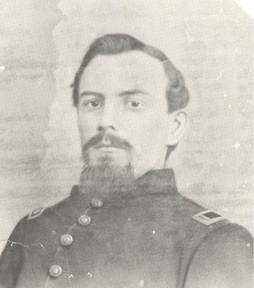
E. B. Doane was not as successful in civilian life as his friends and
comrades-in-arms. Maj. Root commanded a colored brigade for a time, then became
a United States Marshal, and later owner of the Brazelton House in Mount
Pleasant
and an influential politician. W. I. Babb returned to school, and was elected to
office in Lee County for many years thereafter. E. B. Doane returned to
teaching, a profession increasingly dominated by women, but where learning
brought high status to those men who devoted their lives to education. The
professional skills were in great demand. Salem, a town of less than one
thousand people, had two hundred and fifty students in the lower grades, and a
high school of seventy-five students.
Apparently children grew in Iowa even faster than the corn. However, the pay was
low.
The Quaker interest in education,
so important to the Doane family, manifested itself in the establishment of a
college in Salem in the fall of 1867. Eleazar’s father was among the earliest
contributors to Whittier College, and undoubtedly Eleazar was an enthusiastic
supporter of the venture. He was not a teacher there, however, and it is likely
that his poor health had already forced him to seek a more invigorating
livelihood.
Apparently E. B. Doane had returned to farming before the fall of 1869, because
at that time a fight arose that he would not have avoided. The teachers’
association in Henry County denounced the appointed Superintendent of Schools
and proposed his replacement by S. L. Howe. One hundred and fifty teachers
petitioned on behalf of the old abolitionist, saying “some of Iowa’s noblest
sons, and one or two of the Nations best men, have received the rudiments of
their education under his immediate tutorship.”
However, E. B. Doane seemed to have little interest in politics in the period
immediately following the war. His health and the entrenched politicians may
have kept him from attempting to exercise leadership, but he must have
participated in the debates and hotly contested elections, inflamed as they were
by deep emotional and philosophic divisions. Southeastern Iowa had remained in
Democratic Party hands throughout the war, reflecting local sympathy for the
South that the steamboat trade had created. Also, so many Unionists had marched
away to war that the Copperheads could agitate freely, from time to time even
holding public meetings and disrupting pro-Union assemblies. Now the troops were
home, and we know from his earlier letters how E. B. Doane felt about
Copperheads: “If there is anything I detest is a base Copperhead...Oh, but there
is a time coming when such men will wish to God this had been a blank in their
lives.”
The time had come.
The question of Negro suffrage brought the Copperheads and their racist
sympathizers out in numbers in the fall of 1865; the Union men organized as
well. The mass meeting in Keokuk was one of the largest in the history of the
country,
and the Unionists carried the day only thanks to the voters further north.
Banner headlines denouncing the Copperheads appeared in 1866, 1867, and 1868 as
well, but each election resulted in Democratic victories over most of the
country. How inflamed were these contests? Undoubtedly E. B. Doane attended this
rally in Big Mound on October 20, 1868:
Dear Gate:
This is the day and the place for the
Grand Republican Rally of Northwestern Lee. Arriving at the spot, at 11 a.m., I
found to my great satisfaction, that the people had not forgotten to rally; and
that through the unconquerable energy of our esteemed friends, J. Coffindaffer,
D. R. Heaton and others and the loyal ladies, all necessary arrangement had been
perfected to receive and properly care for all who might attend: and that the
hospitalities of the citizens of Big Mound and surrounding country were most
cordially and generously extended to man and beast. Two towering liberty poles
on either side of the road had been erected, and beautifully festooned with
evergreens supporting a splendid emblem of our sovereignty, bearing upon its
ample folds the names of the next president and vice-president of the United
States; and with its warning lines of beauty, inspired each heart with faith in
the ultimate success and triumph of Republicanism. Multitudes had already
assembled, eager and anxious to hear the political issues of the hour discussed
by the speakers billed for the occasion; and as far as the eye could reach, in
every direction, crowds of people were still coming—some in wagons, some as
mounted Tanners,
some in carriages, others on boat, until, by noon, the crowds at the speakers
stand had reached large proportions, and the universal exclamation was, “What -
What’s the matter!!” All conceded that it was by far the largest and most
enthusiastic meeting of the campaign in old Lee up to this writing. No fair
judge estimates the crowd at less than 3000 souls.
One of the most noticeable features of
the meeting and procession was a tastefully decorated chariot, drawn by six fine
specimens of horses, and filled with thirty-seven blooming maidens, named after
each state. Petroleum V. Nasby, P. M. “which is post-master,” was there, with an
old rickety buggy, and a horse with one foot in the grave, and the other ought
to have been there; with a tall stove pipe hat, which looked like it had gone
through all the wars, and in the awful fix of the “Democracy,” pretty well
“busted up;” labeled so that all could read, “Do you want your daughters to
marry niggers?” and fastened to the seat of his dilapidated vehicle, with the
Democratic platform, and labeled in large capital, “Equal Taxation.”
I need not say this unique picture
created a sensation, and that the few “Dimmycrats” in attendance were strongly
inclined to keep Nasby company, owing to the talismanic power of a certain pig
heretofore alluded to.
A rich and splendid repast was spread on
tables erected in Bro. Coffindaffer’s yard, (Who by the way is entitled to
special mention for his zealous efforts in the Republican cause.) The tables
fairly groaned under the luxuries and substantials, but were soon relieved by
from 350 to 400 Tanners, who partook of dinner and supper, with joyous faces and
grateful hearts, attesting their appreciation by cheer after cheer for the good
ladies of Big Mound and vicinity.
At the call of the vast concourse of men
and women, Col. Leighton came forward and made one of the most humorous,
mirth-provoking speeches it has ever been my good fortune to hear—keeping every
one for nearly an hour in the laughing mood.
He paid a just tribute to our
Congressional standard-bearer, and reviewed in denunciatory terms his
competitor—the poor old silly Maryland carpet-bagger, alias Tom Clagett, who
imagines that he is a candidate for Congress. Col. Leighton believes that “a
little nonsense now and then is relished by the wisest men.” At the conclusion
of his happy effort, and whilst the immense concourse of people were still
smiling audibly, the President introduced Gov. Stone, who at once proceeded to
make one of the most powerful and logical speeches ever delivered to the State.
His scathing and withering denunciations of the modern Democracy elicited round
after round of rapturous applause, and stamped him as one of the ablest men in
the nation. His triumphant vindication of republican principles, and his
condemnation of copperhead doctrines, were fully appreciated by his auditors,
and will bear rich fruits on November 3rd, 1868. The meeting, with all its
concomitants was all that any lover of freedom and good government could wish.
Agate
But the Tanners could not prevail over their Lee County opponents. The defeat in
`68 was particularly galling, especially since the incumbent officials seemed
more interested in protecting their own interests than in presenting their
constituency. By the late summer of 1869 there were calls for new blood in the
party, and a purge of corruption.
E. B. Doane presented himself that September in Charlestown as delegate from
Cedar Township to the County Convention. On the Committee for Resolutions, he
helped draft the following statement:
Resolved, That the resolution of the State Republican platform, against
excessive taxation, extravagance in expenditure, and in favor of employing the
surplus funds of the State Treasury to carry on the State Administration,
economically administered, and to collect only the minimum of taxation required
for this and no other purpose, meets our hearty concurrence. Resolved, That by
resolution we understand that the Republican party of Iowa pledged itself
unequivocally against building a new State House at this time; and that we ask
our members of the General Assembly to be governed by that pledge. Resolved,
That the unparalleled extravagance of expenditure in the county administration
of Lee county calls imperatively for prompt and thorough reform; that for this
extravagance the dominant party in the county is responsible, and for a complete
and satisfactory reform, the people of the county must place the control of its
affairs into new and honest hands. Resolved, That the ticket nominated to-day
commands our fullest confidence, and that we will give our earnest efforts to
secure its success.
The subsequent elections produced the desired results. With the ticket headed by
the editor of the Gate City Weekly, who was elected United States
Senator, The Republican vote climbed. E. B. Doane, a subscriber to the paper and
an acquaintance of the former editor, moved up with the fortunes of the party.
In 1870 he went to the State Convention in Des Moines, where, with fourteen
other delegates from Lee County, he supported the party statement:
Resolved, That we refer with pride to the history of the Republican Party, and
congratulate the people of the country upon its successful career. It has given
to the poor man a homestead; it has abolished slavery, and established manhood
suffrage; crushed treason, given us the Pacific Railroad, settled the doctrine
of right of expatriation, maintained the honor, integrity, and credit of our
nation; it has vindicated the Monroe doctrine by preventing foreign powers from
interfering with the governments on this continent; and to perpetuate it in
power is the only safe guarantee for peace and prosperity in the future.
He did not serve
in 1871, but in 1872 he met with the 1st District Convention in Burlington.
The happy result of that election was that for the first time, the Republican
Party carried Lee County! That was his last party convention in Iowa. The next
year found him in Kansas.
The railroads were opening up the west. The railroad through Cedar township was
delayed by corruption and legal difficulties, but it opened the way north and
south early in the 70s. Other roads smoothed the past west, and soon pioneers
were writing back to their friends in Iowa that Kansas was the place to live:
“The country is beautiful, and will richly reward those who select a home
here...I feel no hesitation in recommending this portion of the country to the
emigrant.”
“When you told me in Keokuk this was a beautiful country you did not express
half the facts. It is not only beautiful, but perfectly delightful, and even
grand.”
Most correspondents recommended travel by rail, and in 1873 a veritable flood of
Iowans set out for cheap land in Kansas, selling their farms in Iowa and staking
everything on the future.
Crops had not done well in Iowa for several years, and the Panic of 1873 was
catastrophic to small farmers. The Homestead Act provided relief, especially for
veterans, and E. B. Doane and his comrades took the opportunity to improve their
lot. The law provided that each settler would receive 160 acres of land if he
occupied it and improved it for five years; furthermore, he could preempt
another 160 acres at $1.25 an acre. The Timber Culture Act granted an additional
160 acres to a settler if he planted forty acres of trees upon it. In 1873 or
1874 E. B. Doane reportedly drove a covered wagon to Kansas and took up a
homestead and timber claim in Osborne County.
He never lost contact with friends and relatives in Iowa, or even with his
wife’s family in Ohio, but distance was such as to prevent anyone visiting
except on very rare occasions. Although relatives returned to Iowa occasionally,
there is no evidence that E. B. ever did so; he maintained communication by mail
with his father,
but even that was irregular. Robert Doane remained in Iowa, his savings
supplemented by a government pension. He survived until 1889, a respected member
of his community.
A letter survives, apparently from Amelia’s mother, Mrs. Davis, who lived in
Mount Hamil, in northwestern Lee County, Iowa. She survived until 1901, and one
of her letters, perhaps her last, though undated, was preserved. Spelling and
punctuation were extremely poor, but her loneliness and weakness are most
eloquent:
Dear Amelia,
I hope you are all well. I received your and Lizze’s letters. I hope the baby is
alright. I have a cradle fixed for him; will send it when I have a chance. I had
a letter from my boy. I like to get letters from any of the folks, for it does
me so much good. I have not felt able to answer them for I am poorly. Been in
bed most part of the last week; am so weak can barely get around the room. I
felt poorly most part of the winter. It seems to me I am thinner and weaker.
Mattie thinks when the weather gets warmer I feel better. If I don’t I do not
get through the summer. I try hard to keep around and wait on myself for I know
the rest has much to do to take care of themselves...
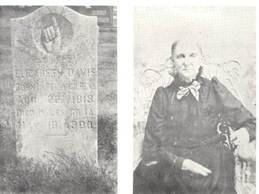
Elizabeth Davis continued to write about the possibility of a visit, but
concluded that she was too weak to endure the long train trip with the frequent
changes. If correspondence was not frequent, it was at least regular enough that
distant lines of Doanes, Cahills, and Davis never lost contact in spite of the
many miles between them. Some Iowa relatives made visits to Osborne County,
often to visit those family members who had married E. B. and Amelia’s children.
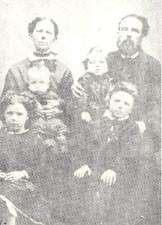 Osborne
County is located in north central Kansas, an arid, treeless area except for the
fertile valleys that cut through the rolling hills. The South Fork of the
Solomon River runs through the northern and the county seat in Osborne. The
census of 1870 found thirty-three settlers in the county, but a boom began in
1873 with large-scale immigration from Iowa and other states so that by 1880 the
census recorded 12,518 inhabitants.
Osborne
County is located in north central Kansas, an arid, treeless area except for the
fertile valleys that cut through the rolling hills. The South Fork of the
Solomon River runs through the northern and the county seat in Osborne. The
census of 1870 found thirty-three settlers in the county, but a boom began in
1873 with large-scale immigration from Iowa and other states so that by 1880 the
census recorded 12,518 inhabitants.
Many neighbors joined E. B. Doane in the earliest migration. A Quaker settlement
grew up at Mt. Ayr, and veterans from the 19th Iowa Infantry and the
8th Iowa Cavalry appeared in almost every township. E. B. Doane made
a claim on land in Delhi township where he built a small log cabin on a creek
near the geodetic center of the United States, just north of the Mead ranch. His
family then included four children (Frank, Eva Jane, Robert Boyd, and John).
With six mouths to feed, he hurried to get his first seed in the ground,
undoubtedly corn. But there was no crop in 1874. The grasshoppers came, as the
newspaper reported:
The grasshoppers made their advent into our country the latter part of the week,
and are devouring everything before them. We noticed several fields of corn
literally alive with them, being almost unable to see either the corn or the
ground. We hear reports of their ravages from every portion of Osborne and Rooks
counties and up to this writing they are still with us, carrying on their work
of desolation and ruin among the field of our farmers.
The grasshoppers returned in 1875. The “Kansas or Bust” settlers survived,
thanks in part to relief committees established in Iowa to send food and
clothing. Doubtless, the relatives of E. B. Doane gave his family assistance in
this difficult period.
There were other troubles, as the editor commented two years later:
We understand Mr. Done is in trouble on account of some one jumping his claim.
We read in the good Book that he that knoweth his master’s will and doeth it not
shall be beaten with many stripes. We are surprised that Mr. Done or any other
many should leave the gate open for trouble to step in.
Claim jumping was easy. One needed only to remove one set of markers, replace
them with another, and defend the illegal move by bluff or force. Unfortunately,
we do not know how this came out, but it is unlikely E. B. Doane did nothing
about it. Perhaps a local “claim club” helped to remove the intruder-in any case
he disappeared completely.
The last Indian raid occurred in 1878, when a bunch of starving Cheyenne broke
out of the reservation and started south with their women and children looking
for buffalo. Attacked by cowboys, they retaliated on frontier families. Half the
settlers of Osborne County fled for safety, but E. B. Doane’s homestead was not
in a threatened area. The last buffalo seen in Osborne County passed through
that year.
The area was becoming civilized. There was a “Literary at Delhi every Friday
evening,”
an Odd Fellows Lodge, and a Masonic Lodge installed at Delhi.
E. B. Doane was an Odd Fellow and a Mason. There was singing and partying at the
Prather’s nearby, and a donation party for the minister of the proposed church
there which one hundred and twenty persons attended.
E. B. Doane undoubtedly participated in these activities, and although he never
joined the church and considered himself a Quaker, his children associated
themselves with the church at Delhi and nearby Lucas and became Methodists.
Osborne and the railroad were quite distant from the Doane farm, but two days
haul in the wagon sufficed to bring the produce to market. E. B. Doane made the
trip regularly, often in company with his friends. C. Borin, publisher of an
upstart newspaper, reported his visits:
Capt. Doan, M.N. Purdy and another gentleman whose name we did not learn, of
South Side, told us “how” yesterday.
Capt. Doan was in recently to see us.
Unfortunately, E.
B. Doane was not so friendly with the editor of the opposing, but more durable
newspaper. Borin lasted but two years, and his chatty notices were all too
short.
But the country was not so lonesome now. More people lived in Delhi township,
even relatives. Amelia’s brother James Cahill came west in 1877 after his
grandfather died at the age of 103, married a local girl in 1880, and began to
teach school. And there were three more children (Elizabeth Amelia, Walter
Scott, and Victor Roy).
As little Delhi grew into a crossroads shopping center boasting several stores,
it grew somewhat more independent of Osborne two days journey away. The citizens
hoped for a railroad which would make them a thriving community. The
expectations of things to come caused a rift in the otherwise friendly relations
of the citizens, and this rift was reflected in politics. Since all settlers
were Republicans, the struggle came in the township caucus, where nominations
were made, nomination being tantamount to election. E. B. Doane became involved
in this dispute, rather innocently it appears, but also rather disastrously.
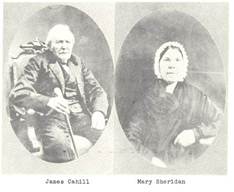 Late in September of 1880, E. B. Doane went to Ohio on business and remained
there three months,
most likely to settle the estate of Amelia’s grandmother Cahill, who had died in
Cincinnati. While he was out of the state, the township trustee died, and in the
newspaper’s words: “E. B. Doane, candidate for District Clerk, had, during his
absence in Ohio on business, been appointed trustee of Delhi township on the
petition of his many friends there.”
That week E. B. Doane’s friends won. But the next week it was different. When
the Republican caucus met, his supporters were outvoted. The split in the
township came into the open, as the losing faction withdrew and elected a rump
delegation to the county convention. The convention was hotly contested, so much
so that the newspaper reported “CONVENTION IS OVER AND NOBODY KILLED, but how
about the Delhi contesting delegation.” The rump lost.
Late in September of 1880, E. B. Doane went to Ohio on business and remained
there three months,
most likely to settle the estate of Amelia’s grandmother Cahill, who had died in
Cincinnati. While he was out of the state, the township trustee died, and in the
newspaper’s words: “E. B. Doane, candidate for District Clerk, had, during his
absence in Ohio on business, been appointed trustee of Delhi township on the
petition of his many friends there.”
That week E. B. Doane’s friends won. But the next week it was different. When
the Republican caucus met, his supporters were outvoted. The split in the
township came into the open, as the losing faction withdrew and elected a rump
delegation to the county convention. The convention was hotly contested, so much
so that the newspaper reported “CONVENTION IS OVER AND NOBODY KILLED, but how
about the Delhi contesting delegation.” The rump lost.
To make a long story short, there were plenty of bad tempers left over from the
convention. The newspaper reported three weeks later, “Oh, What beautiful
weather! But a cloud still hangs over Delhi.”
And E. B. Doane was blamed for part of it. The winning faction crowed in the
Farmer:
Our election news is daily coming in from various parts of the township, the
latest report being to the effect that Mr. Purdy, the defeated candidate for
trustee, is indignant at Mr. E. B. Doane for not complying with a sacred
contract made by them about one month before the county convention. Mr. Purdy
solemnly pledged himself to Mr. Doane that he should have the office of district
clerk, while Mr. Doane pledged himself that Mr. Purdy should have the office of
trustee of Delhi township. Mr. Purdy, to make his calling and election sure,
went into the fight with his gloves off. My referring to a number of the
Truthteller published during October, you will see that Mr. Purdy faithfully
complied with his part of the contract. In that article Mr. Purdy tells the
voters of Osborne county that Mr. Doane is a competent man, and also a
republican, never having been a greenbacker; also that he was a great warrior,
the first stroke he made in the late war knocking off and entire corner of the
rebellion. Mr. Doane failed to fell his fellow citizens of Delhi township that
Mr. Purdy was a second monitor during the war, and this negligence on Mr.
Doane’s part is supposed to have caused Mr. Purdy’s defeat.
Delhi Ring
E. B. Doane’s friendship with Marion Purdy seems to have survived this crisis,
if there really was one. But neither was able to regain influence on township
politics. The Delhi Ring remained in control.
E. B. Doane must have returned from Ohio before Christmas. In January he visited
Osborne and the short conversation with the editor of the Truth Teller
occasioned several short notices in the paper:
We were heartily glad to shake Capt. Doane by the hand recently. He had just
returned from Ohio, where he has been for the past three months.
Born—on the 15th, to Mr. & Mrs. Doane, of South Side, a son. All well. (That was
Ray Gue).
J. W. Middaugh, who came out recently to visit his brother-in-law, Capt. Doane
of South Side, came to this city and took the train yesterday for his home in
Lee county, Iowa. He pleased us by making a call in company with friends Doane,
and will hereafter read the Truth Teller in his Iowa home. (He married Mary
Annis Doane).
He smoothed out the difficulties with Marion Purdy, and that fall purchased the
old Purdy Farm. E. B. Doane had decided that his family needed a larger home
(two more sons, Ira Bales and Otis Eleazar were born), and he needed more land
to farm.
His far had been of moderate size. He purchased the 320 acres from Marion and
Mary Purdy for one thousand dollars on September 29, 1881.
He transferred the mortgage from the Kansas Trust and Banking Company to the
Mutual Trust Company of Pennsylvania and paid installments of fifty-eight
dollars and seventy-five cents. The second mortgage was still not completely
paid off at the time of his death in 1886. He had another 160 acres in nearby
counties and 260 acres in Reynolds County, Missouri.
It was good wheat country, and E. B. Doane provided himself with all the tools
necessary for wheat farming: a plow, a drag, a wheat drill, three wagons, and
harness and tackle for two teams. He had seven head of horses for work and,
consequently, had to provide fodder for them. He raised hay and clover, and
owned a mowing machine and hay rake for harvesting those crops. On the remaining
land he ran fifty head of cattle and dept about fifty hogs and pigs. These were
for consumption as well as for sale. Naturally, they varied in age, heifers,
yearlings, and calves all being present; and hogs and shoates.
The home was a plain, unpainted one and one-half story farm house, small and
rather depressing. The house was surrounded by trees and bushes; lilacs and
holly hocks and other old-fashioned flowers in front on the east, tamaracks and
currants to the north, and a large peach orchard to the south. There was a small
living room and one bedroom downstairs on the south side of the house, with two
bedrooms upstairs above them; on the north side of the house a large dining room
ran from the front back to the kitchen, which also was a larger room, occupying
the entire rear portion of the house. Above the front porch was an open porch,
and there was a cellar underneath the kitchen. A stone walk led to the cistern
not far from the kitchen door on the south. The barn was built into the hillside
west of the house, and was also surrounded by trees.
The house was filled by a family of twelve persons, and one could find there all
the necessities for life on a new and undeveloped frontier. Luxuries were few.
Even necessities were scarce. So inside the house one found only common
furniture, bedding, the books used by the family and the children in school, the
family Bible, and the musical instruments played by the various members of the
family. Around the house were the outbuildings, never quite completed, and the
animals. There were two cows for milk, several pigs, the spay horse, the tools,
the fuel and the provisions, and probably a few stray chickens.
Most of the land was not yet fenced, and labor had to be hired. Some years saw
little rain; others saw locusts and other insect pests; and winters could be
severe. The land was but a few years removed from the buffaloes and the Indians,
and while those had passed far away already, the land itself was not yet tamed.
Nevertheless, E. B. Doane persevered and even prospered in a small way. By 1886
he had saved over $1300 which he planned to invest in improvements, and indeed,
at the time of his death he was bringing back a herd of animals, largely horses,
but a mule also, to improve his holdings. And he was hiring labor to finish his
outbuildings and fences.
He kept busy in other ways also. In 1882 someone had burned the school house,
after carrying out the benches and books. E. B. Doane set out to build a proper
structure which could be used for religious services as well. The funds were
raised by private subscription, but he did most of the work himself.
This was later known as the “Old Doane School,” located on a corner of his
property. He finished it that summer, in time for his numerous children to use
it.
Unhappily, E. B. Doane’s health continued to deteriorate. He had, in truth,
never recovered fully from being ill in the war. The camp fevers and the prison
camp hardships had undermined his constitution permanently. He suffered from
such chronic intestinal difficulties that he was unable to work either as a
teacher or a full-time farmer.
This disability became increasingly severe, so that early in 1884 he applied for
an Invalid Pension from the government. But it was delayed on the grounds that
further depositions were necessary, and on March 16, 1886, the application was
returned from Washington.
Finally his doctors advised him to go to Arkansas, in hopes that the mineral
waters then would benefit his weakened condition. In late August of 1886 he
drove his team to Siloam Springs, Arkansas, and lived there in his wagon.
On September 14th he wrote his last letter home:
Dear Wife and Family,
Your letter of August 30th and Pension
Certificate were here when I arrived Sunday night. I was glad to hear from home
and to know that all is well. The weather is and has been for 3 or 4 days very
damp and windy, with some rain, and the herd in mud. I feel better this morning
than I did yesterday. Have not got about much and won’t until the weather’s
better or I feel better. Charley is still with me. We have got into a house and
the horses in a pasture in day hire and a stable at night. Bird stood the trip
better than Beck. The last two days were very rough road and shook me so that I
am sore. Yes, I want that *stone work pushed along. Get Zero to hire Charley and
if Jo is needed about getting more stone better keep him too. I want a pasture
fenced. Better fence what is north of my timber clump and east of the road on
the section line. Better have them finish cutting the corn and hay first...I’ll
send money to get the wire & posts with also to pay Jo and Charley and Zero. I
want them to crowd the stone work so that I can get the Barn up before cold
weather...I saw Abe and Elwood Smith & Dudly Kerney, they are all here.
Abe and I are going hunting the latter part of the week if I am able. I’ll send
the Pension Certified to Topeka and get it cashed and then I’ll send the money.
The water here is having some effect on me but I can’t tell yet whether it will
help or not. I’ll try it a while anyway. I am going to get some dried Apples to
fetch home. As soon as they can after the corn is cut have them fence the
Pasture so the children can go to school. Have you any school yet? If Valentine
wants to sell that 1/4 I’ll take the west 80 at whatever Mead thinks he can give
for the east one. I am getting tired and will close. Hoping this will find you
all well. Write often & let me know how the Money is getting. I wouldn’t sell
the Hogs until they are fat. Have Sharpe look at that clover and when he thinks
it is ready to cut. Have the boys mow it up...
yours truly
E. B. Doane
He died suddenly October 5. The next day Mr. Morris, Cashier of the Bank of
Siloam wrote:
Mrs. E. B. Doane
Delhi, Kansas
Dear Madam
I suppose by the time this reaches you,
you will have rec’d the corpse of your husband. He died very sudden at this
place at about 3 o’clock. Mr. Doane at the time of his death had in this Bank
1324 & 80/100 dollars less exchange 2.50. He had a pension Draft in his pocket
for 27.75 and in cash 1.80 and had 20 ponies in the pasture also, 1 Jack. He got
the stock within 2 miles of this place last night & in the company with 2 other
men came on into town and after eating a harty supper went to bed in a wagon
with a hand but was taken sick in the night and died soon after calling the hand
up. I have assumed the expense of the coffin and buryal expenses, also furnished
money to express the corpse to you and sent it to the RR tonight & it will start
from Rogers on the 2 PM train Oct 7th. I will furnish money to send the stock
right on to the farm by D. H. Karney who was with Mr. Doane while he was down to
Ft. Smith and helped him buy the stock. And as soon as I find out what expense
there is to be paid out, I will advise you. I don’t think it would be best for
the stock to be stopped here, therefore, I advance the money to sent it to you
as also the corpse. I don’t know on what grounds Mr. Doane drew his pension but
if it was for any trouble of the bowels or stomach, you had better have a post
mortem examination made before you buerry, as if you can show that he died from
the causes as set forth in his pension claim you will be entitled to a Widow’s
Pension and if you can’t show sutch to be the cause of his death you will not be
able to obtain a widow’s pension. My advice would be that you have him examined
by a good Physician before you berry him. As I said will write you again soon
and will forward the stock in care D. H. Karney. I am very respectfully.
R. S. Morris
The local paper gave the following announcement:
E. B. Doane died at Hot Springs, Arkansas...(he) had been in failing health for
some time past and a few months since went thither in the hope of receiving
benefit from the mineral waters and change in climate. Mr. Doane was a well
known citizen of this county, having resided in the southeastern portion from
the very earliest date of settlement, and he will be sincerely missed by a large
circle of acquaintances. His remains were sent home for burial which took place
Sunday under Masonic auspices.
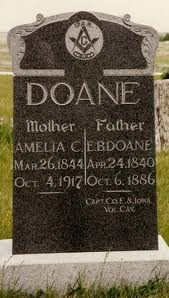
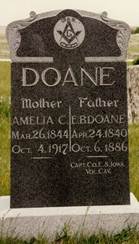
It remained only to settle the estate. A first settlement was filed October 15,
1886, and a final account December 8, 1889. The estate was reduced from $3090 to
$2447 by mortgage and tax payments in the interim and went to the widow.
His father, Robert Doane, died Jan. 1, 1889, leaving a farm of 212 acres in Lee
County and ten acres of timber in Henry County; the homestead was far from his
original log cabin, now consisting of a “handsome farm dwelling, a good barn,
and all the necessary and convenient outhouses.” The county history reported
that in his last years he had been “surrounded by a large company of warm and
sympathetic friends.” He had been active in community affairs and loyal to the
Society of Friends.”
E. B. Doane’s life and death were representative of his era. He experienced all
the joys and sorrows of the times. In his youth he saw the rise of great issues;
national unity and the abolition of human slavery soon enough became battle
cries, and he could not stand idly by. While still a young man he served with
distinction in the bitterest war in this nation’s history. He lost his brother
and many friends in that great conflict, almost perished himself, and suffered
the ill-effects for the remainder of his life. But he had fought for a world
which did not yet exist and he must have been disappointed to see how the ideals
were betrayed or circumvented in the ensuing years. The Republican era which
promised unlimited expansion and prosperity brought hitherto unparalleled
corruption and depression. Nevertheless, despite his physical weakness, he stood
by the party of his hopes and fought for its regeneration. It was a good fight,
both in Iowa and in Kansas, but he usually went down to defeat; perhaps because
he stood for a Republicanism that existed more in rhetoric that in reality. As
the pioneer spirit stirred again, driving hundreds of thousands to resettle in
the states to the west, he, too, was swept along, there to encounter new and
dangerous difficulties. On the almost treeless plains he built a home, put in
his crops, and reared his children. Opposed by nature and his fellow man, his
survival was short. Inadequate diet and the hardships of taming the land cost
him what remained of his health and he died young, leaving a widow and many
small children in that hostile environment.
Indeed,
at that point it should be asked whether his courage, courage proven as it was
in battle and in life, was equal to that shown by his widow. But he had lived
for a dream, and if he could have foreseen the future, he would probably have
considered the sacrifices a reasonable exchange.
Children:
Frank
Ithamer Doane (April 15, 1866, in Doantown, Iowa [later called Cottonwood Falls
– Nov 21,1939, in Hot Springs, New Mexico).
He moved to Indian Territory in 1883 and lived there until 1894 when he moved
farther west for five years, then returning to Indian Territory. He later
lived in Arizona and New Mexico, was a U. S. Commissioner of Indian Affairs and
had a ranch at Rodeo, N.M.
Eva
Jane Doane Stark (Sept 17, 1868 in Lee County, Iowa – Feb 4, 1931).
m. July 25, 1888, Alvia E. Stark of Osborne Co. She was a member of the Arriba
Congregational Church.
Robert
Boyd Doane (April 6, 1871, in Cottonwood, Iowa – February 23,1936 in Stockton,
Kansas);
married Carmelia Goodin.
John Doane (Feb 1, 1873 – August 12, 1945, in Osborne, Kansas);
married Alice M. Standley 3 May 1893, in Clarinda, Iowa. Taught school for a few
years and later served 6 terms as county clerk; elected to Kansas House of
Representatives for three terms; named Examiner of State Banking Department in
1929 and was appointed assistant receiver for the Commercial State Bank of
Cawker; deacon in the First Christian Church of Osborne. Although in poor health
in his last years, he was able to serve several terms as Sargent-at-Arms in the
State Legislature.
Elizabeth
Amelia Doane Prather (July 27, 1875 in Delhi Township – June 15, 1949, in
Great Bend, Kansas);
a school teacher and active church worker, she married in Osborne, Kan., Dec.
28, 1898, Albert Ross Prather, a farmer; members of Cheyenne United Brethern
Church.
Walter
Scott Doane (August 14, 1877, in Osborne County – December 20, 1945, in Smith
Center, Kansas); married Grace Mason in 1905; in 1910 they drove by
wagon to visit Frank in Arizona, then went on to see the Grand Canyon and
Mexico.
Victor
Ray Doane (April 10, 1879 – January 17, 1944, in Downs, Kansas);
married Minnie Elsie McVey in 1903.
Ray
Gue Doane (January 14, 1881 – Nov 22, 1922); married Gertrude Lucinda
Fay in 1907; graduated with the first class of the Kansas Medical College in
1910and opened his practice in Lucas, Kansas.
Ira
Bales Doane (Dec 13, 1882 – August 28,1940, in Denver); married Nell
Yarnell in 1911; was a Sergeant in the 99th company, Coast Guard
Artillery Corps; died in an automobile accident in a dust storm while going to
visit his daughter.
Otis
Eleazer Doane (May 15, 1884 – August 17,1963, in Osborne); he
completed his B.A. degree in 1924; his M.A. 1930, at Ft. Hays State College;
taught school for 39 years in public schools of Kansas and Nebraska; also an
instructor in the Federal Reformatory in Chillicothe, Ohio, and in the Boys
Industrial School, Topeka. He served as Supt. of schools in Sherman Co., Kansas;
engaged in agricultural pursuits and a life long member of the Presbyterian
Church
E.B.Doane’s boys
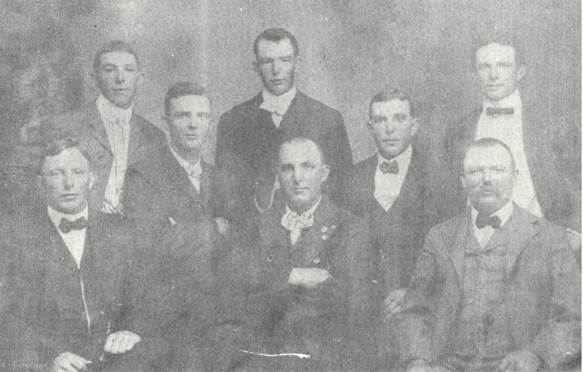
Appendix B National Park Service Summary of 8th Iowa Cavalry
activities
Organized at Davenport September 30, 1863. Moved to Chattanooga, Tenn., October
17-22, thence to Nashville, Tenn., November 14-16. Attached to Defences of
Nashville & Northwestern Railroad, Dept. of the Cumberland, to March, 1864. 1st
Brigade, 1st Division, Cavalry Corps, Army Cumberland, and to November, 1864.
1st Brigade, 1st Division, Cavalry Corps, Military Division Mississippi, to
June, 1865. Dept. of Georgia to August, 1865.
SERVICE.—Guard and garrison
duty and operating against guerrillas at Waverly and points west of Nashville
till March, 1864. Moved to Nashville, Tenn., March 13-17, thence to Chattanooga
and Cleveland, Tenn., April 1-15. Atlanta (Ga.) Campaign May to September.
Varnell’s Station May 7. Demonstration on
Rocky Face Ridge and Dalton May 8-13. Tilton May 13. Battle of
Resaca May 14-15. Near Cassville May 19. Stilesborough May 23.
Burnt Hickory May 24. Operations on line of Pumpkin Vine Creek and battles about
Dallas ,
New Hope Church and Allatoona Hills May 25-June 5. Near Burned
Church May 26. Ackworth June 3-4. Operations about Marietta and against Kenesaw
Mountain June 9-July 2. Lost Mountain June 15-17. Assault on Kenesaw June 27.
Nickajack Creek July 2-5. Chattahoochie River July 6-17. McCook’s Raid on
Atlanta & West Point Railroad July 27-31. Lovejoy Station July 29. Clear Creek
and near Newnan July 30. At Kingston, Ga., till Sept. 17. Pursuit of Wheeler
Sept. 1-8. Moved to Nashville, Tenn., Sept. 17, thence to Franklin, Tenn.
Pursuit of Forest September 25-October 10. Pulaski September 27. Florence, Ala.,
October 6-7. Muscle Shoals near Florence October 30. Near Shoal Creek October
31. Nashville Campaign November-December. Shoal Creek near Florence November 5-6
and 9. On line of Shoal Creek November 16-20. Fouche Springs November 23.
Campbellsville November 24. Front of Columbia November 24-27.
Franklin November 30. Battle of
Nashville December 15-16. Lynnville December 24-25. Pulaski
December 25-26. Expedition into Mississippi January 5-21, 1865. Wilson’s Raid to
Macon, Ga., March 22-May 1. Northport near Tuscaloosa April 3. Occupation of
Tuscaloosa April 4. Occupation of Talladeega April 22. Munford’s Station April
23. Rejoined Wilson at Macon May 1. Duty at Macon and in Georgia till August.
Mustered out August 13, 1865. Regiment lost during service 15 Enlisted men
killed and mortally wounded and 3 Officers and 176 Enlisted men by disease.
Total 194.
AMELIA DOANE AND OLD CHARLIE
When daddy
was a little boy like you are a little girl, his daddy
used to tell him a little story about “Old Charley.”
Old Charley was great grandma’s old, gray horse. Grandma used to come to town a
long, long way and Old Charley brought her. He jogged along with his head down
and great grandma would shake on the lines and say, “gid ap; gid ap Charley,”
and he would lift his ears and step a little faster for a yard to two, then he’d
shut his ear and I guess his eyes too like he was asleep and jogg, joggerty
along. Great Grandma would shake the lines again and say “klick” that little
sound that horses know. Ask daddy to make it for you. Poor great grandma, she
just wore herself out to go to town with Old Charley.
When Old Charley was a “mitty bitty” horse, he used to lick to go into the top
part of the barn to play. You see the old barn was built down beside a hill and
the down hill part was where the big horses stayed and upstairs on the level
ground floor was where great grandma kept her feed for little Charley. She knew
little Charley wouldn’t hurt anything so she didn’t bother him when he ran
around and took a notion to go in the upstairs part of the barn.
Now you see this barn was getting old and the floor upstairs wasn’t very strong
any more but little Charley didn’t know that grand great grandma didn’t think
about the floor so it wasn’t fixed.
One day little Charley was playing and ran so fast into the upstairs part of the
barn that the floor broke right under him and poor little Charley fell right
down where the big horses stayed.
My, how scared he was and how he squealed and great grandma heard the noise and
everyone ran out thinking little Charley would be dead, but he was
just scared and never went to play in the upstairs part
of the barn again.
Gertrude Fay Doane for Diana
Alfred A. Doane, The Doane Family (Boston, 1902), pp. 1-19, 53-6,
80-1.
Portrait and Biographical Album of Lee County, Iowa
(Chicago, 1887), pp. 288-92. The property was in the southeastern
quarter of section 10.
Louis Thomas Jones, The Quakers of Iowa (Iowa City, 1814), p. 68;
see also The Quakers of Iowa in 1850 and “The Quakers of Iowa in
1858,” Iowa Journal of History and Politics, XII, 262-286,
394-439.
Portrait and Biographical Album of Lee County, Iowa, pp. 288-92;
Family Bible (Philadelphia: Bible Association of Friends in
America, 1850), and obituary in possession of Ralph Doane of Downs,
Kansas; The Doane Family,
639 .
Records of Births, Salem Monthly Meeting (1782-1890); Record
of Deaths, Salem Monthly Meeting, Book A; the initial request for
membership was made in 5th month. A committee visited the family, and
reported that they were “not so well satisfied as they wished to be.”
Another Friend was sent, who reported “middling good satisfaction.”
Finally in 10th month approval was given, if White Lick Meeting
concurred. Minutes, Salem Monthly Meeting, Book C, pp. 84-5, 89,
104, 113, 115-6. These records are now in the archives of Iowa Yearly
Meeting (Oskaloosa, Iowa).
Minutes, Salem Monthly meeting, Book C, pp. 128-9.
Portrait
and Biographical Album of Lee County;
his farm was worth eight hundred dollars and his equipment five hundred
dollars. Lee County records, Fort Madison (Iowa) Courthouse; The
Doane Family, 723, notes
that Ruth Doane died in 1875 and that they had fourteen children, some
of whom seem to have remained in Indiana.
Minutes,
Salem Monthly Meeting, Book C, pp. 72, 81, 88: Book D, pp. 150, 153.
Jones,
Quakers of Iowa, pp. 133-45, 187-91; Alfred Doane said that David
Doane's father hated “human slavery, a sentiment which has been fully
shared by all descendants.” David's brothers John and Joseph were
“staunch Abolitionists in the days when it tried men's souls to be such,
and the oppressed and needy of whatever race or color ever found with
them that best of all aid, help to help themselves,” and called them
“pronounced Abolitionist(s) of the Garrison, Phillips and Birney Type.”
Doane Family, pp. 225-6, 291-2.
Iowa Journal of History and Politics,
xxxv, 116-21; in 1867 Robert Doane contributed to support of Whittier
College, named for the prominent Quaker poet. An offspring institution
now exists in California, established by Friends immigrating from Iowa.
History of Henry County Iowa
(Chicago, 1879), pp. 448-51, 569.
Letter to Amelia Cahill,
June 22, 1884.
Military record of E.B. Doane, National Archives.
The Burlington (Iowa) Hawkeye, July 14, 1862, p. 2.
Ibid.,
July 28, 1862, p. 2.
Mount Pleasant (Iowa) Home Journal, Sept. 13, 1862, p. 3.
Her mother, Elizabeth Wallace (b. August 22, 1819) had married James
Cahill Jr on Sept. 16, 1843; he died of cholera in 1849, leaving her
with the only surviving child, Amelia (b. 1843) and pregnant with James.
In 1852 she married John Davis (born 1822 in Tennessee) and moved with
him to Lee County, Iowa, leaving James with his grandfather to be raised
as a catholic; they had two children, the Rev. Joseph Ivins Davis (a
Presbyterian minister) and Almyra.
The Census of 1860 for Harrison Township in Lee County listed John
Davis, age 39; Elizabeth, age 39; Benjamin, age 12 (obviously from an
earlier marriage); Joseph, 9; Almira, 5; Amelia Cahill, 15; Mary J.
Cahill, 13.
Military Record, National Archives.
Keokuk
(Iowa) Weekly Gate City, Sept. 3, 1862, p. 1.
Letter
from THS in the Burlington (Iowa) Hawkeye, November 8, 1862, p.
2.
From Crane Creek, Mo., Nov. 7, 1862, in Mount Pleasant Home Journal,
Nov. 22, 1862, p. 2.
S.H.M. Byers, Iowa in War Times (Des Moines, 1888), p. 517.
Lurton Dunham Ingersoll, Iowa and the Rebellion (Philadelphia,
1866), pp. 326-7.
Ibid.,
327-330; A member of Blunt's relief column wrote that the Confederates
apparently planned to overwhelm the smaller army before help could
arrive, but “when they ran upon General Herron they caught a
'tartar.'...The Iowa regiments engaged, and more especially the 19th,
has added greatly to the enviable reputation of our Iowa soldiers. The
three companies from Louisa and Henry suffered perhaps more than any
others. They fought like tigers and fell like soldiers, making two
villains bite the dust for each one of them that fell.” Letter in the
Burlington Hawkeye, Dec. 22, 1862, p. 2; another wrote “We had a
chance to observe that part of the field where General Herron was
engaged. The rebels were ranged along the brow of a woody hill, while on
the open bottom below were stationed the gallant divisions of Herron and
Trotter. Nearest us was the 20th Iowa. The 19th Iowa and 20th
Wisconsin were first engaged, and time after time did with thinned
ranks...Today is the third day, and as I passed over the field many of
the dead rebels are yet unburied. They are lying in pens built to
prevent the hogs from devouring them as they have done in some
instances.” The Burlington Hawkeye, Dec. 29, 1862, p. 2; “The 19th
Iowa, although a comparatively
new regiment, performed deeds of valor that have not been excelled by
any other regiment during the war. Led by the gallant Lieutenant-Colonel
McFarland, they charged upon a battery; took it, and were on the point
of removing it within our lines, when the rebels in overwhelming numbers
rushed from the brush and fell upon them and forced them back with great
slaughter...The carnage was fearful. Forty-five were killed outright,
and one hundred and forty-five wounded, many of them mortally. Henry
County was represented by Co. K, Capt. Roderick, and well did he and his
men do their duty, showing a larger list of killed and wounded than any
other company engaged in the fight. Well may our citizens be proud of
him and his brave men.” Mount Pleasant Home Journal, Jan. 3,
1863, p. 1; See also Harper's Weekly, Jan. 17, 1863, pp. 40-46.
The
War of the Rebellion. A compilation of the official records of the Union
and Confederate Armies.
Washington: Government Printing Office, 1888. Series I, vol. XII, part
I, p. 131.
http://members.aol.com/wis20th/or/or7.html
Military Record, National Archives.
Byers, Iowa in War Times, p. 517.
Special Orders #3. Headquarters, Department of the Missouri, January 3,
1863; military and pension records, National Archives; Mount Pleasant
Home Journal, Feb. 7, 1863, p. 2, and May 9, 1863, p. 3.
Letter from E.B. Doane to Amelia Cahill, April 10, 1864.
History of Henry County, Iowa,
p. 490; military record, National Archives.
Letter from Camp Roberts, September 10, 1863.
Military record, National Archives.
Letter from Private John Head from Nashville, Nov. 18, in the Burlington
(Iowa) Hawkeye, Nov. 24, 1863, p. 2.
Letter from Nashville, Nov. 18, in Mount Pleasant Home Journal,
Nov. 28, 1863, p. 2.
Ibid.,
Feb. 2, 1864, p. 2.
Letter from T. Bird, Nov. 29th, in Mount Pleasant Home Journal,
Dec. 12, 1863, p. 2.
“The First Kansas Battery,” Collections of the Kansas State
Historical Society, XIV (1915-18), p. 271; War of the Rebellion,
Series 1, Vol. XXXI, part 3, p. 28.
The best sources for the activity of the 8th Iowa are Ingersoll's
Iowa and the Rebellion; Homer Mead's The Eighth Iowa Cavalry in
the Civil War (Carthage, Ill., 1925); Roster of Iowa Soldiers in
the War of the Rebellion (ed. Brig. Gen. Gerry E. Logan, Des Moines,
1910), IV, 1507021; and A.A. Stuart's Iowa Colonels and Regiments
(Des Moines, 1865).
Letter from J.C.P. from Waverly, Tennessee, December 23rd, in the
Burlington Hawkeye, Jan. 11, 1864, p. 2.
Letter in Mount Pleasant Home Journal, Dec. 19, 1863. p. 2,
written Dec. 11, 1863 from Sec. 32, Nashville and Northwestern Railroad,
Tennessee.
Keokuk (Iowa) Daily Gate City, Jan. 19, 1864, p. 1, and the
Weekly Gate City, Jan. 20,1864, p. 3, written from Sec. 32,
Nashville and Northwestern Railroad, Tennessee, Jan. 4, 1864.
”The First Kansas Battery,” pp. 273-4.
Ingersoll, Iowa and the Rebellion, pp. 695-6.
War of the Rebellion, Series 1, Vol. XXXI, part II, p. 125; part
III, pp. 446, 558; Vol. XXXII, part II, p. 270.
Jacob D. Cox, Atlanta (Campaigns of the Civil War, IX, New York,
1882), pp. 15-16.
Probably his sister Mary.
This part of the letter touches upon a number of important points
regarding the public attitude toward the war. The war was widely
unpopular, but for various reasons. The Society of Friends was opposed
to war, but supported the war aims of the Lincoln administration. Salem
Friends would probably object to a religious meeting in honor of the
soldiers, but apparently this reference is to the Presbyterian Church,
where the membership would be divided over different issues. There were
many Copperheads, that is, democrats opposed to the war. On the national
scene they were numerous and active, and the government fought them by
every means at its command, some unconstitutional, such as illegal
arrest and trail by military tribunals. In Lee County, both legal and
illegal means of suppression were used. The “Skunk River War” ended
after the murder of two leading Copperheads and the treat of troop
intervention. 1863 being an election year, emotions were high. See Frank
L. Klement's The Copperheads in the Middle West (Chicago, 1960)
and Robert Rutland's “The Copperheads of Iowa: A Reexamination,” Iowa
Journal of History, LII (Jan. 1954), 1-30.
February 26, 1864, from Camp Gillam.
Letter from New Orleans; Military Records, National Archives.
Mount Pleasant Home Journal, March 19, 1864, p. 1, written March
5th.
Ingersoll, Iowa and the Rebellion, p. 696; Cox, Atlanta,
pp. 19-25; War of the Rebellion, Series I, Vol. XXXII, part III,
p. 557.
Pension Record of E. B. Doane, National Archives; Promotion came May 12.
Military Record, National Archives.
April 10, 1864, from Chattanooga, Tennessee.
The Chaplain from Nashville, April 6th, in the Burlington Hawkeye,
April 14, 1864.
Joseph Donner from Cleveland, Tennessee, April 21st, in the Hawkeye,
May 3, 1864.
”The history of General Sherman’s one hundred consecutive days of
fighting is also the history of my regiment. The cavalry opened the
fight every morning and watched the enemy all night. The 8th
Iowa Cavalry brought on the first two engagements, and at Varnell
Station, I heard my first shell shriek and explode overhead, resulting
in casualties to our regiment and the next day at Tilton Station learned
what a half bushel of bullets thrown at you in a cluster sound like.”
Mead, The Eighth Iowa Cavalry, p. 12; Joseph Downer wrote home:
“It has been over a month since we started on this expedition and in
that time we have mostly lived in the saddle or dismounted, and in the
line of battle...We were two weeks without mail till day before
yesterday it came up, and I assure you that letters from home and
friends were never more eagerly read.” June 9th, in Burlington
Hawkeye, June 25, 1864.
H. T. Bird from Lost Mountain, Georgia, June 24th: “At Cassville...our
regiment gave them a charge, which was more than they had bargained for.
They did not even stop to gather up their cartridge boxes upon the
ground behind their works.” Mount Pleasant Home Journal, July 9,
1864, p.2; War of the Rebellion, Series I, Vol. XXXVIII, part II,
p. 752.
Ingersoll, Iowa and the Rebellion, p. 696; Cox, Atlanta,
pp. 33-84.
H. T. Bird from Lost Mountain, Georgia, June 24: “We at present have
only 300 mounted men in the regiment. The remainder who are dismounted
are at Kingston, performing guard duty. This campaign has been very hard
both upon the men and horses, for we have pushed the enemy so closely
that it has been impossible for us to have even half rations.” Mount
Pleasant Home Journal, July 9, 1864, p.2.
Pension Records, National Archives.
Governor Stone of Iowa was General of the 22nd Iowa Infantry and elected
while still at the battlefront.
July 22, 1864, Nashville, Tennessee; He and three other officers were
listed among patients at Officer's Hospital. Burlington Hawkeye,
July 30, 1864.
E. B. Doane had not yet recovered fully, but he was anxious to rejoin
his regiment and requested special permission. Pension records, National
Archives.
Cox, Atlanta, pp. 144-189; Ingersoll, Iowa and the Rebellion,
p. 698.
W.I. Babb, letter August 7, 1864, from Marietta, Georgia, Mount Pleasant
Home Journal, August 20, 1864, p.1.
Letter written from Pulaski, Tennessee, October 16, 1864, in the
Burlington Hawkeye, October 24, 1864.
Ingersoll, Iowa and the Rebellion, pp. 698-9.
War of the Rebellion,
Series I, Vol. XXXVIII, part II, pp. 769-773 contains his full report;
pp. 776-7 contains Major Root’s report.
August 17, 1864, Military Prison, Macon, Georgia.
August 18, 1864, Military Prison, Charleston, S.C.
A list of prisoners appeared in the Burlington Hawkeye, September
26, 1864. The exchange was announced in the Hawkeye, October 17th
in a letter from Franklin, Tennessee, October 9th.
Pension Records, National Archives; War of the Rebellion, Series
II, Vol. VII, indicates that officers tried to escape in September of
1864 and make their way to the blockading fleet, pp. 774-5.
Military record, National Archives.
Pension record, National Archives.
War of the Rebellion,
Series II, Vol. II, p. 1090. The camp was actually only five acres. Food
consisted of cornmeal and sorghum molasses, causing prisoners to call it
“Camp Sorghum.”
James
M. Gere, Escape to the Mountains,
The life of a northern Civil War soldier, including his personal account
of his escape from a Confederate prison.
Captain James M. Gere (1824-1908) Company H, 122nd Regiment, New York
Volunteer Infantry
(private printing. 2011).
Andrew M Benson of Portland, Maine, a captain in the First District of
Columbia Cavalry.
April 10, 1865. Military record, National Archives.
April 13, 1865. Military record, National Archives.
His friend, B.C. Maris, was a witness. Pension record, National
Archives; Family Bible. A Rev. Bloofield Wall was Pastor of
Sharon Presbyterian Church from 1865 to 1866. There was also an
Evangelical or Reformed Church of Primrose.
Lt. Anderson wrote May 1st of the members of Co. E. who were killed and
captured. Mount Pleasant Home Journal, May 26, 1865.
Letter from Macon, Georgia, May 9, Ibid, June 2, 1865.
Col Dorr had died May 8th
of illness.
Military record, National Archives.
June 15, 1865, Macon, Georgia.
Military record, National Archives.
Pension and Military records, National Archives. It should be noted that
there are many minor discrepancies in dates in the pension records. A
good example is the discharge date, which because of the above mentioned
difficulties, varies from July 15th July 23rd to August 1st. Actually,
the discharge was not printed until 1870. Another is E.B. Doane's
deposition for William Grisham that the latter was wounded in June of
1865 near Pulaski, Tennessee, in support of a battery. E.B. Doane swore
to this in 1877 and is probably in error; He had returned home in time
to participate in the 4th of July celebration at Big Mound by assisting
in reading the Declaration of Independence. Weekly Gate City
(Keokuk, Iowa), June 17, 1865.
A large, impressive hotel which was still operating prosperously in
2011.
Henry County Press,
November 11, 1868.
Letter, February 26, 1864.
Weekly Gate City,
August 26, 1865.
Clubs of Union Veterans, soon supplanted by the Grand Army of the
Republic.
Ibid,
September 15, 1869.
Ibid,
June 1, August 17 and 24, 1870.
Ibid,
Letter from Butler County, March 15, 1871.
Ibid,
Letter from Larned, April 1872.
Robert Doane died Jan. 1, 1889. In his last years he may have lived with
son, David Tunis Doane, near Cottonwood, then near Stockport, Iowa (a
town referred to locally as “Doanesville”). David, born 1847, had been
too young to serve in the war. Mary Amis had married John Middaugh and
lived in the area.
Pension records of Ithamar Doane, National Archives; Portrait and
Biographical Album of Lee County, Iowa, pp. 288-92.
Letter from “Mont Hamell, Iowa,” March 30.
Most prominently the Prathers. Elizabeth Amelia had married Albert Ross
Prather in 1898 in Osborne. Eva Jane had married Alvia Stark in 1888.
Elizabeth Davis died May 18, 1900, and was buried in Mount Hamill
cemetery in Lee County, Iowa.
Osborne (Kansas) Times, July 30, 1874; see Everett Dick, The
Sod House Frontier (New York, 1937).
Osborne (Kansas) Farmer, October 19, 1877, p.1.
Donald P. Doane, his grandson, when asked about this, turned a bit
choleric and said, “E.B. Doane would have gotten his navy pistol out and
settled that.”
Osborne Farmer, December 9, 1880.
Ibid.,
June 15, November 30, 1882.
The
Truth Teller.
Osborne, Kansas. July 7, 1880, p. 5.
Ibid.,
July 28, 1880, p. 5.
Ibid., September 22, 1880.
Ibid.,
October 20, 1990; Osborne Farmer, February 3, 1881.
The Truth Teller,
November 10, 1880.
Osborne Farmer, February 10, 1881.
The Truth Teller,
January 19, 1881.
W2SE4 & SE4SE4 Sec.5, and SW4SW4
Sec. 4, 10, 11 (160A) in Delhi Township (10), Range 11, West of Sixth
Meridian. Deed B F, p. 137, Osborne County.
Osborne County Probate Records, October 15, 1886; January 4, 1887.
Letter, September 14, 1886.
Osborne Farmer, January 11, 1882; June 17, 1886; August 12, 1886.
J. M. Evans, his doctor from 1869-1872 in Salem, Iowa, affirmed this in
1886. Letter in possession of Leslie Doane; J. Greech of Tipton, Kansas,
stated that “Eleazar B. Doane is now and has been since my acquaintance
(with) him unable to perform hard labor on account of Chronic Diarhea,
Scurvy, and Piles; That he is now and has had since my acquaintance with
him (to) hire his labor performed; that sudden changes of weather
prostrate him so he is unable to go; that changes of diet or water
frequently have the same effect; and that of light labor such as driving
a team in good weather or indoor work is not more than half-a-hand and
has not been since 1874.” May 7 1883. Letter in possession of Leslie
Doane; William Sample of Jewell Co., Kansas, confirmed this. “During all
the said time he was not able to do more than 1/2 one man’s labor in
good weather and in bad weather none at all.” Affidavit of April 6,
1886, in possession of Leslie Doane.
Letter from Department of Interior Commissioner, J.C. Black.
Deposition of Drs. Hall and Hudson. Osborne County Records. Dr. Hudson
was examining physician for government pensioners.
These were all close friends. The Farmer reported on June 17,
1886, that “It is probably not generally known that Abe Smith has been
in the mercantile business at Siloam Springs, Ark., for the past six
months. Uncle Abe no doubt makes as much of a success at store keeping
in Arkansas as he formerly did of politics and farming in Osborne
county. In whatever business he may engage his hundreds of friends in
this county wish him success.”
He drew up a list of the stock entrusted to D. H. Karney and sent it
also.
The Osborne Farmer, October 14, 1886.
Portrait and Biographical Album of Lee County, Iowa,
p. 292.

