| Volume 77 |
Spring 2003 |
Number 2 |
| Eta Sigma Phi and Chicago: The Connection | ||
|
Editor’s
Note: When the nominations for the best
adapted screenplay were announced at the Academy Awards ceremony in March,
there was one name that, though probably unknown to most listeners, should
have been recognized by members of Eta Sigma Phi. The original play on which
both the Broadway and Hollywood musicals Chicago
were based was written by
Maurine Dallas Watkins, for whom Eta Sigma Phi’s translation contests are
named. On her death in 1969, Eta Sigma Phi received a bequest of $10,000,
which became the seed money of the endowment which supports the summer
scholarships, and her name was given to the translation contests. The
following reminiscence was written by Kappa Alpha Theta’s fraternity
archivist for the Kappa Alpha
Theta Magazine and is
reprinted here with the permission of Ms. Arnold and the editor of the
magazine. Mary
Edith Arnold "This
one’s got the makin’s: wine, woman, jazz, a lover." — newspaper
reporter Jake Callahan in Chicago.
Ladies, lovers, liquor —
and all that jazz. Not only the intriguing elements of the current movie Chicago,
but also the circumstances behind two true-life murders in the Roaring ’20s
that launched the writing career of a Theta from Butler University’s Gamma
Chapter. |
Watkins recognized the headline-making opportunity in the crimes involving Belva Gaertner and Beulah Annan and helped turn them into media sensations. After both were acquitted, Watkins penned Chicago as a satire of crime, celebrity, and the creation of image. Born in 1896 in
Louisville, Kentucky, Watkins began writing as a young girl — producing
plays, founding her high school newspaper, and writing short stories. After
graduating from high school in Indiana, she attended Hamilton and she found
herself covering Gaertner and Annan. Her witty and wry humor turned the trials
— and Watkins’ by-line — into After graduating from high school in
Indiana, she attended Hamilton and Transylvania Colleges Watkins’ journalism career began at the Chicago Tribune in 1924 she found herself covering Gaertner and Annan. Her witty and wry humor turned the trials — and Watkins’ by-line — into front-page news. After the trials, Watkins moved to New York, where she worked as an editor and continued to study playwriting under Baker, then at the newly formed Yale School of Drama. It was in Baker’s classes that she wrote Chicago. Chicago, with the same tongue-in-cheek humor exhibited in her newspaper columns, vaulted Watkins to national fame when it opened on Broadway on December 30, 1926. The play ran for 172 performances before touring at home |
Maurine
Dallas Watkins
The
film of Chicago stars
and abroad. Within a year Chicago was produced as a silent film, supervised by Cecil B. De Mille. It also was the basis for the 1942 film Roxie Hart, starring Ginger Rogers. Following Chicago’s success, Broadway producers pursued Watkins for new works to mount, but those plans didn’t materialize. Only one other Watkins play opened on Broadway — Revelry (1927), adapted from the S. H. Adams novel about the Teapot Dome scandal. It had a modest run of 48 performances. Watkins then moved to Hollywood and worked for the major movie studios Continued on page 2
|
 in
Kentucky and Butler College in Indianapolis, Indiana, graduating in 1919.
Watkins later pursued graduate work at Radcliffe, studying playwriting under
George Pierce Baker, America’s foremost teacher in the field at the time.
in
Kentucky and Butler College in Indianapolis, Indiana, graduating in 1919.
Watkins later pursued graduate work at Radcliffe, studying playwriting under
George Pierce Baker, America’s foremost teacher in the field at the time.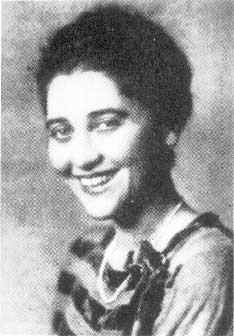
HOME Currently Reading Page 1 of Nuntius Spring 2003
