The question whether Zeus or Moira controls human and divine affairs occurs to any reader of the Iliad. At times, Zeus seems to reign supreme; at others, Moira seems to raise up to challenge his omnipotence. By studying Zeus’ strength in its many manifestations, illustrated by his control over men and gods through both word and action, and then by considering the manner in which the powers of Moira in three specific examples relate to the influence of the Father of the gods, I hope to demonstrate Zeus’ superiority to Moira.
A brief survey of ideas offered by various scholars reveals that thought on the subject of the relative powers of Zeus and Moira tends to divide into three branches. The first affirms that Zeus reigns supreme; the second that Moira holds greater sway than does Zeus; and the third that Moira does not exist except as the inevitable about which the gods, the poet, and the audience are prescient.
The first branch of thought claims that men, gods, and Moira alike ultimately acquiesce to the will of Zeus. Lloyd-Jones points out that men in the Iliad would often choose different paths if Zeus did not place savage ate in their breasts.1 Adkins remarks that "only Zeus can promote his plans from a distance, and only Zeus’ plans, however his attention may be distracted in the meantime, triumph in the end."2 The authors of the relevant entry in the Oxford Classical Dictionary say that Zeus does not submit to Moira even when he raises the golden scales to determine mortal destinies. "The golden scales are a façon de parler, a poetic device, to raise the tension at a critical moment in the narrative by appearing to create a momentary doubt regarding the outcome of an event which always firmly remains in the control of Zeus."3 Therefore, these scholars hold up Zeus as ultimate authority.
It is evident, however, that the question of Zeus’ superiority leaves itself open to further examination, since, as many critics aver, Moira sometimes seems to
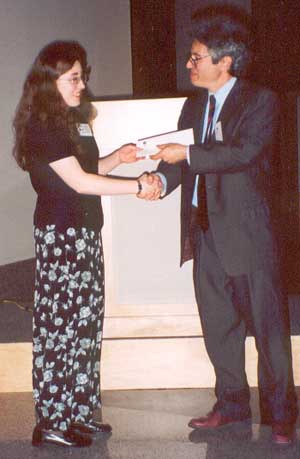
Becky Tompkins receives her award from
Professor Levine at the banquet on Saturday night.
have greater power than Zeus and to hold decisive authority concerning death. Even Adkins himself states that the gods would never choose the death of a man they love, and therefore, "there must be something which can override the gods, something which cannot be propitiated."4 Otto argues that the gods, "cannot shield the living from the death which is determined for him."5 According to this school of thought, then, Moira has supremacy over Zeus to prolong or cut short a life.
The third group of critics suggests that Moira exists as a symbol for the things about which the gods, the poet, and the audience have foreknowledge. That is to say, the gods know what will happen, the poet creates the story, and the audience knows the basic plot. As Whitman says, "the ‘fate’ which [Zeus] must acknowledge is the poet’s scenario viewed as ineluctable fact, and herein lies the real meaning of the frequent phrases, ‘according to
fate’ and ‘contrary to fate.’"6 Furthermore, Morrison emphasizes that the audience in Homer’s time already knows the storyline and that its "foreknowledge" constrains the flow of the poem. Instead of violating "fate" as defined thus, he continues, the poet develops his storytelling techniques by making clear that, "were it not for a specific action at the last moment, the story of the Trojan War would have been fundamentally altered. " Thus, the aforementioned group of scholars rejects the traditional definition of Moira in favor of foreknowledge personified.
Keeping in mind the three main ways of approaching the relationship between Zeus and Moira: whether Zeus holds ultimate power, Moira plays a trump on Zeus, or Moira simply symbolizes things foreknown, helps the consideration of the Iliad itself. Careful study of the textual examples concerning Zeus and Moira reveals that the idea that Zeus reigns supreme presents fewer difficulties than the second and third approaches delineated already.
Let us look into the Iliad in more detail. Zeus shows his power over both men and gods, exhibiting it at many different times through both word and action. He holds perfect power over men, controlling them without question. His supremacy over his fellow gods also holds firm, though they can divert his plans more successfully than mortals can. Zeus himself speaks of his power as supreme, saying, "No word or work of mine — nothing can be revoked, / there is no treachery, nothing left unfinished / once I bow my head to say it shall be done" (1. 629-631).7
Throughout the Iliad, Zeus shows his power over the world. He exhibits his power in several capacities, as ruler, granter of prayer, giver of victory, and leveler of doom. This multi-faceted strength magnifies Zeus as ultimate power and authority. Thetis, the mother of Achilles, describes Zeus’ power over the world as ruler when she exhorts him: "exalt [Achilles], Olympian Zeus: your urgings rule the world!" (1. 606). Trojans

